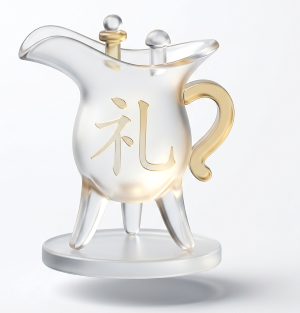
Loyalty is the cornerstone of Book 1: "Philosophy & Values." As the opening element of the "Philosophy & Values" (108 Elements) collection, it serves as the essential point of departure for our cultural journey. In the traditional Chinese moral framework, one’s commitment to the state and the preservation of justice must precede the refinement of individual rituals or aesthetic pursuits. It is the prerequisite for all other social virtues, establishing the necessary order from which harmony can emerge.
At its essence, Zhong (Loyalty) represents a steadfast devotion to country, duty, and justice. Within the Muzi framework, it is defined as the bedrock of social responsibility—the moral anchor that binds the individual to the collective and ensures the stability of the social fabric.
In the Chinese tradition, Loyalty is not a blind obedience but a multidimensional commitment constructed upon three primary pillars: Country, Duty, and Justice. Commitment to "Country" transcends mere nationalism, representing a deep-seated devotion to the collective well-being and the continuity of the civilization. "Duty" is framed as Ke Jin Zhi Shou (恪尽职守), the sincere fulfillment of one's specific role and obligations within the social hierarchy. Finally, "Justice" aligns Loyalty with Yi (Righteousness) in the public sphere, ensuring that one’s devotion is guided by moral rightness and equitable principles rather than personal gain. Within the "Philosophy & Values" context, these pillars form the foundation of social responsibility, directing individual conduct toward the service of the greater good and the preservation of communal integrity.
Within the architectural depth of Book 1, Loyalty serves as the guardian of the moral code, inextricably linked to the following elements:
Link to Filial Piety Filial PietyC2
Link to Righteousness RighteousnessC4
Link to Benevolence BenevolenceC5
Link to Integrity IntegrityC7
Link to Confucianism ConfucianismC8
The name of this platform, "Muzi Speaks of Ice" (木子语冰), is a deliberate nod to the Zhuangzi, which famously notes that one cannot speak of ice to a summer insect. In our fast-paced modern "summer"—a world characterized by fleeting trends and immediate gratification—the eternal virtues of the past can seem like the "ice" of a distant winter. Yet, it is precisely this frozen, enduring wisdom that provides the structure we lack today.
The iconography of Book 1, featuring a Dragon encircling the "Harmony" (和) symbol, is vital to understanding this chapter. The Dragon represents the auspicious power and authority of the state, but this power remains chaotic without a guiding heart of "Harmony." Loyalty acts as the guardian of this moral bedrock. Without the "ice" of Zhong to solidify our commitments, the "Harmony" of the social and cosmic order would simply melt away. By centering ourselves in Loyalty, we ensure that the Dragon’s strength is governed by peace and balance.