Ming salt-yard commoner who became Wang Yangming's disciple and, teaching that the Way lies in ordinary people's daily lives, founded the Taizhou school
Mural guide
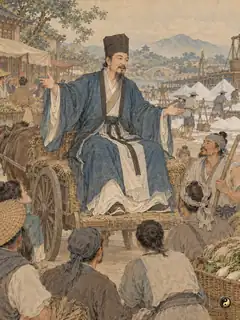
Mural of the event “Wang Yangming's Mind-Learning”, which this person took part in.
By mid Ming the Cheng-Zhu Neo-Confucianism had increasingly ossified into an examination tool, and the literati grew daily skeptical of the outward-seeking Way of investigating-things. Wang Yangming, exiled to Longchang Station in Guizhou, fell into spiritual anguish and urgently sought a new path for Confucianism.
Wang Gen, courtesy name Ruzhi, styled Xinzhai, came from a hereditary salt-boiling family at Anfengchang in Taizhou and was first named Wang Yin. Too poor to stay at school, he once took his father's place at forced labour in winter, and taught himself from the Classic of Filial Piety, the Analects and the Great Learning. In 1520 he went to Jiangxi to debate Wang Yangming, was won over and became his disciple, and Wang renamed him Gen. He then drove a cart of his own making to the capital, preaching to crowds along the way, which so displeased his teacher that Wang Gen had to kneel and apologise before he was received again. Never taking office, he taught as a commoner that the Way lies in ordinary people's daily lives, and his followers were mostly commoners. He died at home in January 1541. The History of Ming names him and Wang Ji as the disciples who best carried on Wang Yangming's school.
1508Wang Yangming's Mind-LearningTook partage 25Wang Yangming taught that mind is principle and knowledge must unite with action, challenging the dominant Cheng-Zhu interpretation of learning.
Investigating things, preserving the self, and the daily life of ordinary people
Ming period
Wang Gen explained gewu this way: the self and the world are one thing, the self is the root and family, state and world are the branches, and whenever conduct fails, one should look back to oneself; so to order family, state and the world depends on preserving the self. He also said the Way of the sage is no different from the daily life of ordinary people. The Ming shi records that he read only the Classic of Filial Piety, the Analects and the Great Learning, and that he spoke off the cuff yet to the point.

 Ming

 Literature · Prose

