Late Ming loyalist scholar from Yuyao who, after years of failed resistance against the Qing, settled in Japan and became guest teacher to Tokugawa Mitsukuni of Mito
Mural guide
A thatched pavilion open on three sides stands among tall bamboo; one person sits with their back turned at the veranda rail beside a zither and a stack of bamboo slips, while a stone path runs to a calm pond reflecting clouds and distant hills.
Zhu Shunshui, born Zhu Zhiyu with the courtesy name Luyu or Chuyu, came from Yuyao in Zhejiang and as a late Ming licentiate repeatedly declined official appointments. After the Qing conquest he joined the loyalist cause of the Prince of Lu and Zheng Chenggong, sailing between Zhoushan, Japan and Annam in search of troops and aid. When Zheng's assault on Nanjing failed in 1659 he crossed to Nagasaki that winter and never returned, and the Yanagawa domain scholar Ando Seian became his student. In 1665 Tokugawa Mitsukuni, lord of Mito, brought him to Edo as an honoured teacher, and he lectured to the Mito domain and advised on the compilation of the Great History of Japan (Dai Nihon shi). He died in Edo in 1682 and was buried on Zuiryu hill in Mito with the private posthumous name Wengong, and his collected writings in twenty-eight chapters were printed in Japan in 1715.
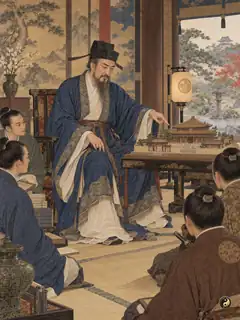
Zhu Zhiyu, courtesy name Luyu, was a licentiate of Yuyao. He first stayed at Nagasaki, where Andō Seian studied under him, and later went to Edo as guest tutor of the Mito domain. The account of his daily talk on learning says he judged Cheng-Zhu and Lu-Wang without losing his balance, valued usefulness in action, and held that learning is like making a fur coat: pick what is pure.

 Ming
 Qing
 Literature · Sayings