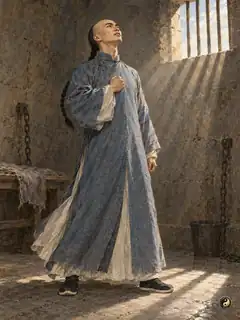
Reformer from Liuyang, author of An Exposition of Benevolence, who joined the Grand Council secretariat in the 1898 reforms and was executed after refusing to flee
Mural guide
Mural of the event “Hundred Days' Reform”, which this person took part in.
Defeat in the First Sino-Japanese War ignited the imperialist scramble for concessions; Kang Youwei and Liang Qichao mobilized scholars in the 'Gongche Petition' demanding radical reform.
Tan Sitong, styled Fusheng and Zhuangfei, was from Liuyang in Hunan, a son of the Hubei governor Tan Jixun. He travelled widely, served on Liu Jintang's staff in Xinjiang and wrote An Exposition of Benevolence (Renxue) while an expectant prefect at Nanjing. From 1897 he helped Governor Chen Baozhen with reforms in Hunan, presiding over the Southern Study Society and working with the School of Current Affairs and the Hunan Daily. Summoned to Beijing in 1898, he was made a secretary of the Grand Council with fourth-rank status and, with Yang Rui, Liu Guangdi and Lin Xu, handled reform business. When the Empress Dowager resumed control that autumn, Liang Qichao urged him to escape to Japan, but he replied that some must leave to plan for the future and some must die to repay the emperor, and stayed. He was arrested and beheaded at Caishikou with five others, remembered as the Six Gentlemen of 1898. Liang Qichao wrote his biography and serialised Renxue in the Qingyi bao.
The Draft History of the Qing says Tan Sitong, courtesy name Fusheng, from Liuyang in Hunan, was bold in youth and held great ambitions. His learning centered on daily renewal, and he gave little weight to the old teachings on human relations. When Chen Baozhen governed Hunan he returned home to assist the new policies, and when Liang Qichao founded the Southern Study Society he became its head. His works include On Benevolence and the poems of the Mangcangcang Studio.

 Qing

 Literature · Prose
