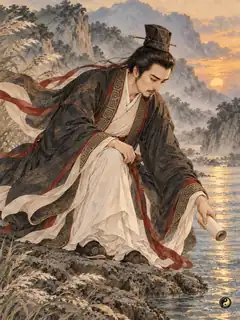
Jia Yi of Luoyang was known at eighteen for reciting the classics and writing well, and the governor of Henan took him into service. Emperor Wen made him an erudite and within a year a grand palace master; he urged the court to store grain and support farming, and proposed changing the calendar, court colors, official titles and rites. Opposed by Zhou Bo, Guan Ying and other ministers, he was sent away as tutor to the King of Changsha, writing a lament for Qu Yuan at the Xiang River and the 'Rhapsody on the Owl'. Recalled as tutor to King Huai of Liang, he submitted a memorial on government that advised dividing the great fiefs among many lords to weaken them. When the king died after a fall from his horse, Jia Yi blamed himself and died within a year, aged thirty-three. Sima Qian paired him with Qu Yuan in a joint biography and quoted *The Faults of Qin* (*Guo Qin lun*) after the First Emperor's annals.
Life and times
Dates 200 BCE–168 BCE
EraHan
Records
Wrote a rhapsody mourning Qu Yuan
In the reign of Emperor Wen of HanThe Records of the Grand Historian says Master Jia, exiled to Changsha, wrote a rhapsody mourning Qu Yuan on crossing the Xiang, and later, when an owl flew into his lodging, wrote another to console himself. Summoned by Emperor Wen as erudite in his twenties, he rose within a year to grand master of the palace, and served as tutor to the King of Changsha and the King Huai of Liang, dying at thirty-three.
References (1)
- 史記/卷084 · Wikisource (Chinese)
Proposed new institutions, many of which the court adopted
In the reign of Emperor Wen of HanThe Records of the Grand Historian says Master Jia held that after some twenty years of Han rule the calendar should be changed, the colour of dress, institutions and official titles set, and rites and music promoted; Emperor Wen, newly enthroned, was too modest to act, but the revisions of the statutes and the sending of the marquises to their fiefs all came from Jia's proposals. He also repeatedly memorialised that kingdoms spanning several commanderies were against ancient usage and should be gradually reduced.
References (1)
- 史記/卷084 · Wikisource (Chinese)