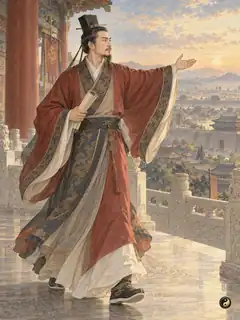
Eastern Han historian who wrote the History of the Han, the first dynastic history covering a single dynasty, and died in prison after Dou Xian's fall
Mural guide
In an archive hall, tall wooden shelves hold scrolls and bound books with small tags, and one person climbs a ladder with their back turned; a long table in front holds an unrolled river map, a bronze lamp and a copper jug, with a city wall seen through the window.
Ban Gu, courtesy name Mengjian, came from Anling in Fufeng, near modern Xianyang; he was the son of Ban Biao and the elder brother of Ban Chao. His father died before finishing a sequel to the Records of the Grand Historian, and when Ban Gu took up the work he was denounced for privately revising state history and jailed, until Ban Chao petitioned the throne and Emperor Ming, having read the draft, made him a clerk of the Lantai archive. Over twenty years he wrote the History of the Han (Hanshu), from the founder to Wang Mang and creating the model for single-dynasty histories. After the White Tiger Hall conference of 79 he compiled the Baihu tong, and he also wrote the Rhapsody on the Two Capitals. In 89 he joined Dou Xian's campaign against the northern Xiongnu, and in 92, when Dou Xian fell, he died in prison at Luoyang. His sister Ban Zhao and Ma Xu completed the eight tables and the treatise on astronomy.
92Ban Zhao Continues HistoryPrecursorage 60Ban Zhao completed the Book of Han at Dongguan Library, taught master scholars, and advised Empress Deng Sui.
92 CEDied
Works
Literature · Prose113
Book of HanHanBan Gu's Eastern Han history of the Western Han, the first history of a single dynasty
Took up his father's history and worked on it for over twenty years
From the Yongping to the Jianchu years, Eastern Han
The Later Han History says Ban Gu, courtesy name Mengjian, found the earlier history continued by his father Ban Biao incomplete and set himself to finish it. Someone informed the emperor that he was privately revising the national history; he was later made a clerk of the Orchid Terrace, received his commission in the Yongping years and, after more than twenty years of close thought, completed the work in the Jianchu years.
Presented the Two Capitals Fu; forty-one pieces were extant
Eastern Han
The Later Han History records that Ban Gu presented the Fu on the Two Capitals. His biography also lists his writings, among them the Dian yin, the Guest's Challenge and the Reply to Criticism, and poems, fu, inscriptions, elegies, eulogies, letters, essays, records, discussions and six-character pieces, of which forty-one were extant.

 Han

 Literature · Prose


