Eastern Jin court historian who wrote the Annals of Jin and compiled In Search of the Supernatural, a collection of tales of spirits, omens and marvels
Mural guide
In an archive hall, tall wooden shelves hold scrolls and bound books with small tags, and one person climbs a ladder with their back turned; a long table in front holds an unrolled river map, a bronze lamp and a copper jug, with a city wall seen through the window.
Gan Bao, courtesy name Lingsheng, came from Xincai, the grandson of a Wu general. Studious and widely read, he was summoned to the court's editorial office for his talent and made a marquis within the passes for his part in suppressing the rebel Du Tao. Early in the Eastern Jin, with no historians yet appointed, Wang Dao recommended him to compile the dynastic history, and his Annals of Jin (Jinji), covering fifty-three years in twenty chapters, was praised as concise, candid and tactful. He later governed Shanyin and Shi'an and served on Wang Dao's staff and as cavalier attendant-in-ordinary. The Book of Jin (Jinshu) says that family wonders, a maid found alive in his father's tomb after ten years and a brother who revived days after ceasing to breathe, led him to collect supernatural tales in thirty chapters, In Search of the Supernatural (Soushen ji), of which a later twenty-chapter compilation survives. Liu Tan called him the Dong Hu of ghosts, after the upright historian of ancient Jin.
Took charge of the national history and wrote the Jin ji
Jin dynasty
The Book of Jin says Gan Bao, courtesy name Lingsheng, of Xincai, was summoned as a court historian for his talent. An order directed Gan Bao and others to start compiling the national history, and he then began to take charge of it. He wrote the Jin ji, covering fifty-three years from Emperor Xuan to Emperor Min in twenty chapters, and submitted it. The work was concise and direct yet tactful, and all called it a good history.
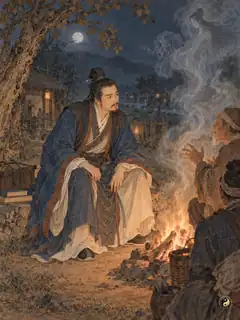
The Book of Jin says Gan Bao gathered accounts of gods, spirits, marvels and the transformations of people, past and present, and named the collection Soushen ji, in thirty chapters. When he showed it to Liu Tan, Liu said, "You may be called the Dong Hu of ghosts." He also wrote the Chunqiu Zuoshi yiwaizhuan, annotated the Zhou yi and the Zhouguan in dozens of pieces, and his miscellaneous writings circulated as well.

 Jin
 Literature · Fiction