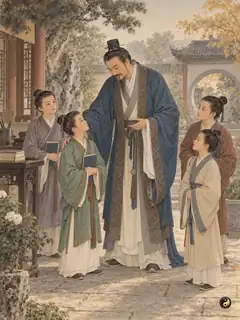
Scholar from a Langya family who served the Liang, Northern Qi, Northern Zhou and Sui courts and wrote the Family Instructions for the Yan Clan, twenty chapters of advice to his descendants
Mural guide
A thatched pavilion open on three sides stands among tall bamboo; one person sits with their back turned at the veranda rail beside a zither and a stack of bamboo slips, while a stone path runs to a calm pond reflecting clouds and distant hills.
Yan Zhitui, courtesy name Jie, belonged to the Yan family of Linyi in Langya; his father served Xiao Yi, Prince of Xiangdong, and Zhitui was born in 531. He too served in Xiao Yi's household, was briefly captured in Hou Jing's rebellion, and when Western Wei took Jiangling in 554 was carried off to the northwest. About two years later he fled by boat down the flooded Yellow River to Northern Qi, where he became a gentleman of the yellow gate and governor of Pingyuan. After Qi fell he served Northern Zhou as a censor, and under the Sui the crown prince Yang Yong made him an academician; his death year is unrecorded. His rhapsody Contemplating My Life recounts his wanderings, and his Family Instructions for the Yan Clan (Yanshi jiaxun) covers child-rearing, household management, phonology and writing. Lu Fayan's preface to the Qieyun rhyme book names him among eight scholars who settled its rhymes, and his grandson Yan Shigu later annotated the History of the Han.
Author of Guan wo sheng fu and thirty juan of prose
From the Liang and Northern Qi into the early Sui
The Northern Qi History, in its chapter on men of letters, says Yan Zhitui read widely, wrote with ornate feeling, composed the Guan wo sheng fu, whose style it calls pure and far-reaching, and left thirty volumes of prose. He was an attendant cavalier in the Liang, a palace attendant in the Northern Qi and prefect of Pingyuan at its fall, and died in the Kaihuang years of the Sui.

 Northern and Southern
 Sui
 Literature · Sayings