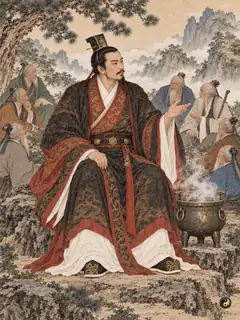
Liu An (179–122 BCE), a grandson of Emperor Gaozu of Han, inherited the title Prince of Huainan. He gathered thousands of scholars and adepts at his court and sponsored the Huainanzi, a syncretic treatise grounded in Daoist thought that also draws on Confucian, Legalist and Yin-Yang ideas. He took his own life in 122 BCE after being accused of rebellion; parables such as 'the old man at the frontier who lost his horse' come from the Huainanzi.
Liu An, Prince of Huainan, was a learned debater who wrote prose well, and Emperor Wu held him in high regard. When the emperor ordered him to write a commentary on the Lisao, he received the order at dawn and presented the finished text by the breakfast hour.
Liu An drew several thousand guests and masters of arts to his court and produced twenty-one inner chapters, many outer books, and a middle section in eight chapters on immortals and alchemy. The closing chapter of the Huainanzi states that the books aim to examine where the Way opens and where it is blocked, so that later ages may know what to do and what to avoid.

 Han
 Literature · Prose

