Late Eastern Han scholar of Cangwu, traditional author of Mouzi's Disposing of Error, an early defence of Buddhism.
Mural guide
In a temple courtyard at dusk, a great bronze bell hangs at the right and incense smoke rises from a bronze urn; monks in orange robes and plainly dressed visitors walk toward a lamplit hall, lotus flowers bloom in a stone basin, and a gold prayer wheel stands at the left.
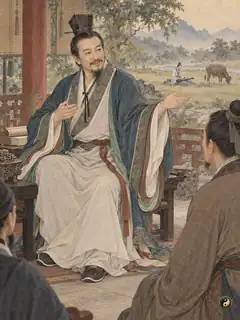
Mou Rong, better known as Mouzi, was a native of Cangwu who took refuge in Jiaozhi during the turmoil at the end of the Eastern Han; versed in Confucian and Daoist learning, he later embraced Buddhism. His Lihuo Lun ('Disposing of Error'), 37 dialogues defending Buddhism by appeal to Chinese classics, is among the earliest Chinese Buddhist treatises. The idioms 'playing the lute to an ox' and 'the less one has seen, the more one marvels' come from it; the traditional attribution to 'Mou Rong of Han' should not be confused with the Grand Commandant Mou Rong of Emperor Zhang's reign.
Life and times
UnknownBornHanlived at the end of the Eastern Han (late 2nd century CE)
UnknownDied
Works
Literature · Fables2
Playing the Lute to a CowHanStory in the Eastern Han Mouzi: Gongming Yi plays refined music to an ox, which keeps grazing
Little Seen, Much Marveled AtHanImage in the Eastern Han Mouzi: those who never saw a camel call it a horse with a swollen back
Literature · Sayings2
Playing the Lute to a CowHanIdiom from Mou Rong's Lihuo Lun: talking over the heads of one's audience
The author of the Lihuo lun calls himself Mouzi, traditionally identified with Mou Rong. He took his mother to Jiaozhi to live apart from the world and at twenty-six returned to Cangwu to marry. The governor, hearing that he held to learning, asked him to take office. He devoted himself to the Buddhist way and also studied the five thousand characters of the Laozi, and he named his treatise Mouzi Lihuo.

 Han
 Literature · Fables