Eastern Han Daoist alchemist traditionally credited with the Cantong Qi, revered as the 'king of alchemical scriptures'.
Mural guide
In a temple courtyard at dusk, a great bronze bell hangs at the right and incense smoke rises from a bronze urn; monks in orange robes and plainly dressed visitors walk toward a lamplit hall, lotus flowers bloom in a stone basin, and a gold prayer wheel stands at the left.
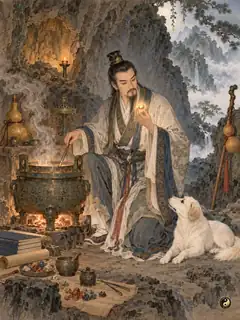
Wei Boyang, from Shangyu in Kuaiji, styled Yunyazi, is traditionally placed in the reign of Emperor Huan of the Eastern Han as a man of good family who declined office to cultivate the Dao. He is credited with the Zhouyi Cantong Qi, which uses the hexagrams of the Book of Changes and Huang-Lao thought to explain alchemy and self-cultivation, later revered by Daoists as the 'king of alchemical scriptures'. Most details of his life come from Daoist sources such as Ge Hong's Biographies of Immortals, and his exact dates cannot be confirmed.
Life and times
UnknownBornHantraditionally placed under Emperor Huan of Eastern Han (147–167 CE)
Said to be in the reign of Emperor Huan, Later Han
Tradition says Wei Boyang was from Shangyu in Kuaiji and, though his family held office for generations, he took no post; he lived quietly in the cultivation of the Way and followed only the Way. According to the preface to the Zhouyi Cantong Qi Fenzhang Tongzhen Yi, he obtained an ancient Dragon and Tiger Classic and wrote the Cantong Qi in three parts on the model of the Book of Changes, then passed it to Chunyu Shutong of the same commandery in the reign of Emperor Huan of Later Han.

 Han
 Literature · Sayings