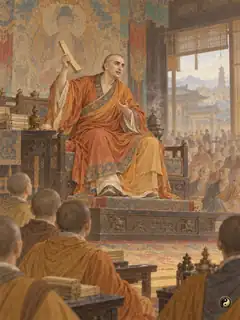
Kuchean master monk who led the Later Qin translation bureau in Chang'an, rendering the Diamond, Lotus and Vimalakirti sutras into Chinese.
Mural guide
In a temple courtyard at dusk, a great bronze bell hangs at the right and incense smoke rises from a bronze urn; monks in orange robes and plainly dressed visitors walk toward a lamplit hall, lotus flowers bloom in a stone basin, and a gold prayer wheel stands at the left.
Kumarajiva (Tongshou in Chinese) was born to an Indian father and a princess of Kucha, became a monk as a child and mastered both Mahayana and Hinayana scriptures, gaining fame throughout the Western Regions. After the Former Qin general Lü Guang took Kucha he was held in Liangzhou for over a decade until Yao Xing of Later Qin welcomed him to Chang'an in 401 as state preceptor and head of the Xiaoyao Garden translation bureau. With his disciples he translated some 300 fascicles, including the Diamond, Lotus and Vimalakirti sutras and the Madhyamaka treatises, whose fluent renderings popularized expressions such as 'inconceivable' and 'the gate of non-duality'.
Left home at seven; received as National Teacher by Yao Xing
Hongshi years, Later Qin
The Lives of Eminent Monks says Kumarajiva left home at seven, received scriptures from a teacher and recited a thousand verses a day. Yao Xing of the Later Qin received him with the courtesy due a National Teacher and showed him great favor; once he had arrived, he was invited into the Ximing Pavilion and the Xiaoyao Garden to translate the scriptures.

 Jin
 Literature · Sayings