Central Indian translator-monk in Northern Liang whose Mahaparinirvana Sutra spread the teaching that all beings possess Buddha-nature.
Mural guide
In a temple courtyard at dusk, a great bronze bell hangs at the right and incense smoke rises from a bronze urn; monks in orange robes and plainly dressed visitors walk toward a lamplit hall, lotus flowers bloom in a stone basin, and a gold prayer wheel stands at the left.
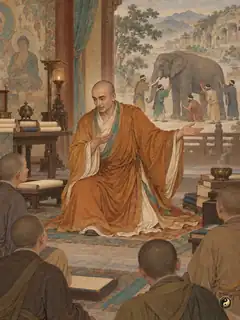
Dharmaksema (Tan Wuchen), a monk from central India, first studied Hinayana and then Mahayana teachings and brought the first part of the Mahaparinirvana Sutra east through Kucha and Dunhuang. Juqu Mengxun of the Northern Liang welcomed him to Guzang, where after three years of learning Chinese he translated the 40-fascicle Nirvana Sutra and the Mahasamnipata, Karunapundarika and Golden Light sutras. He was killed in 433 on Juqu Mengxun's orders while setting out west for more texts; his Nirvana Sutra, with its doctrine of universal Buddha-nature and the parable of the blind men and the elephant, profoundly shaped Buddhist thought of the Northern and Southern Dynasties.
The Blind Men and the ElephantNorthern and SouthernParable from the Nirvana Sutra: blind men each touch one part of an elephant and quarrel
Records
Translated in Hexi; killed by an assassin
Yuanjia 10, Song (death)
The Lives of Eminent Monks says Dharmaksema was a native of Central India. Juqu Mengxun, King of Hexi, held the Liang lands, heard of his name, summoned him and received him warmly. Dharmaksema began translating in the third Xuanshi year, and on the twenty-third day of the tenth month of the tenth Xuanshi year the three cases of scrolls were finished. Mengxun later sent an assassin who killed him on the road; he was forty-nine, and it was the tenth Yuanjia year of the Song.

 Jin
 Northern and Southern
 Literature · Fables