Eastern Jin historian from Shu who served the Cheng-Han state and, after its fall, wrote the Huayang Guozhi, a history and gazetteer of the southwest.
Mural guide
In an archive hall, tall wooden shelves hold scrolls and bound books with small tags, and one person climbs a ladder with their back turned; a long table in front holds an unrolled river map, a bronze lamp and a copper jug, with a city wall seen through the window.
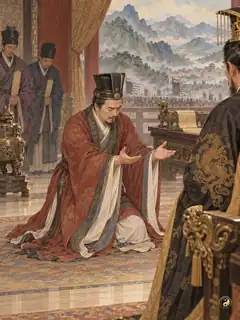
Chang Qu, courtesy name Daojiang, came from a leading family of Jiangyuan in Shu commandery. He served the Cheng-Han state as a cavalier attendant in charge of historical writing. When the Jin general Huan Wen reached Chengdu in 347, the Book of Jin records that Chang Qu and the palace secretary Wang Gu urged the ruler Li Shi to surrender. Under Jin he drew on his earlier writings and local records to compile the Huayang Guozhi, covering the geography, history and notable people of Liang, Yi and Ning provinces from antiquity to 347. It is one of the oldest surviving local histories and a basic source for early Sichuan. His history of the Cheng-Han, the Han zhi shu, is lost.
Life and times
UnknownBornJinCheng-Han cavalier attendant who urged Li Shi to surrender to Jin in 347, then wrote the Huayang Guozhi under Jin (c. 348–354)
Urged Li Shi to surrender and wrote the Record of Huayang
347
The Jin History records that Wang Jia, Director of the Secretariat, and Chang Qu, Cavalier Attendant-in-ordinary, urged Li Shi of Cheng-Han to surrender to Jin. The preface of the Record of Huayang is signed Chang Qu of Jin and says the work ends in the third year of Yonghe (347), in twelve sections, and is titled Record of Huayang.

 Jin
 Literature · Prose