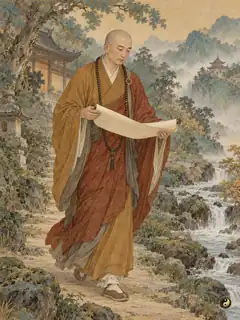
Huijiao, a native of Shangyu in Kuaiji, was a Liang-dynasty monk of Jiaxiang Monastery, learned in both Buddhist and secular letters, who taught in spring and summer and wrote in autumn and winter. Dissatisfied with Baochang's Biographies of Famous Monks, he searched histories and miscellaneous records to compile the Biographies of Eminent Monks in fourteen chapters, covering 67 to 519 CE with 257 main biographies in ten categories such as translators and exegetes. He replaced "famous" with "eminent" to stress conduct over reputation. Fleeing the Hou Jing rebellion, he reached Pencheng in 553 and died there the following year.
Lived at Jiaxiang Monastery, wrote commentaries and lectured
553–554
Huijiao, a native of Shangyu in Kuaiji, was learned in both Buddhist and outside studies and well versed in the scriptures and the monastic rules. He lived at Jiaxiang Monastery, teaching in spring and summer and writing in autumn and winter, and left a ten-chapter commentary on the Nirvana Sutra and a commentary on the Brahma Net Sutra. In 553, at the end of the Liang, he fled the rebellion of Hou Jing to Pencheng and lectured there for a short time; he died in the second month of the following year, aged fifty-eight.
Compiled the Biographies of Eminent Monks in fourteen chapters
Liang (Southern Dynasties)
Huijiao drew on dozens of miscellaneous records and on the histories of the Jin, Song, Qi and Liang to compile the Biographies of Eminent Monks in fourteen chapters, preface and table included. It runs from the tenth year of Yongping under Emperor Ming of the Han to the eighteenth year of Tianjian under the Liang, a span of 453 years, with 257 main biographies and more than 200 further monks mentioned in passing, arranged in ten categories beginning with sutra translation and doctrinal exegesis. Earlier works were mostly titled "famous monks"; he held that a monk of real conduct who did not seek fame was eminent, so he replaced "famous" with "eminent".

 Northern and Southern
 Literature · Prose