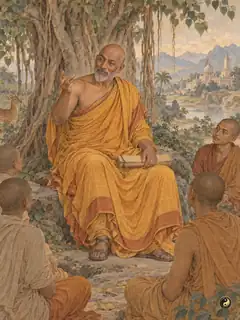
Fifth-century Indian monk who compiled the Hundred Parables Sutra (originally the Garland of Folly), translated into Chinese at Jiankang in 492 by his disciple Gunavrddhi.
Mural guide
In a temple courtyard at dusk, a great bronze bell hangs at the right and incense smoke rises from a bronze urn; monks in orange robes and plainly dressed visitors walk toward a lamplit hall, lotus flowers bloom in a stone basin, and a gold prayer wheel stands at the left.
Sanghasena was an Indian monk of about the fifth century whose life is otherwise unknown. He drew parables from the Buddhist scriptures and compiled them into a collection originally titled the Garland of Folly; its colophon reads 'the Venerable Sanghasena completed the Garland of Folly'. His disciple Gunavrddhi, a monk from central India, came to China and in 492 translated it at Jiankang under the Southern Qi as the Hundred Parables Sutra, as recorded in Sengyou's Chu sanzang jiji. The book teaches Buddhist ideas through simple fables, and idioms such as 'a castle in the air' come from its stories.
Life and times
UnknownBornNorthern and SouthernIndian monk of the 5th century CE; his Hundred Parables was translated into Chinese in 492
UnknownDied
Works
Literature · Fables1
A Tower Built in the AirNorthern and SouthernParable from the Hundred Parables Sutra: a rich fool wants only the top floor of a tower built
Literature · Sayings1
A Tower Built in the AirNorthern and SouthernIdiom from the Hundred Parables: the fool who wanted only the top floor
Records
The Indian monk who composed the Hundred Parables
Southern Qi translation
The Hundred Parables, in full the Sutra of One Hundred Parables, was composed by the ancient Indian monk Jiasina (Sanghasena) and translated by the Indian Tripitaka master Gunavriddhi of the Southern Qi. It consists of ninety-eight tales, the first three being the Fool Who Ate Salt, the Fool Who Gathered Cow's Milk and the Man Who Hit His Head with a Pear.

 Northern and Southern
 Literature · Fables