Northern Song scholar-official who taught the young Cheng brothers and whose Explanation of the Diagram of the Supreme Ultimate became a founding text of Neo-Confucianism
Mural guide
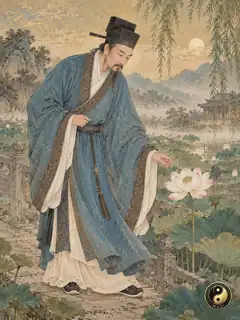
Mural of On the Love of the Lotus, a work by this person.
A lotus rises clean above the pond’s mud as a scholar regards it; chrysanthemum and peony stand nearby. The three flowers make the essay’s reflections on character visible in the garden.
Zhou Dunyi, courtesy name Maoshu, came from Yingdao in Daozhou. Through his uncle Zheng Xiang he entered service as registrar of Fenning county, and he spent most of his career in local posts. In 1046, while legal officer at Nan'an, he was asked by the official Cheng Xiang to teach his two sons, Cheng Hao and Cheng Yi. In his last years he governed Nankang and built a house below Lotus Peak on Mount Lu beside a stream he named Lianxi after the one at his birthplace, so that scholars called him Master Lianxi. His writings include the Explanation of the Diagram of the Supreme Ultimate (Taiji tushuo), Penetrating the Book of Changes (Tongshu) and the short essay "On Loving the Lotus". He died in 1073 and was given the posthumous name Yuan under the Southern Song. Zhu Xi wrote commentaries on his two main works and placed him first in his record of the Cheng school's origins.
Wrote the Diagram of the Supreme Ultimate and the Penetrating the Book of Changes
Northern Song
Zhou Dunyi wrote the Diagram of the Supreme Ultimate, which opens with "the Ultimate of Non-being, which is also the Supreme Ultimate" and goes on to explain how yin and yang and the five phases arise, how humans receive the finest of these and are endowed with spirit, and how the sage, settling matters by the mean, the correct, humaneness and righteousness and holding to stillness, establishes the human standard. He also wrote the Penetrating the Book of Changes in forty chapters, expanding on the meaning of the Supreme Ultimate. While he was judicial clerk at Nan'an Army, Cheng Xiang sent his two sons Cheng Hao and Cheng Yi to study under him; he often told them to look for the joy that Confucius and Yan Hui found, and the History of Song says the learning of the Cheng brothers has its source here.

 Song
 Literature · Sayings

