Northern Song Neo-Confucian thinker known as Master Hengqu, founder of the Guanzhong school, whose Correcting Youthful Ignorance explained all things through the gathering and dispersal of qi
Mural guide
A thatched pavilion open on three sides stands among tall bamboo; one person sits with their back turned at the veranda rail beside a zither and a stack of bamboo slips, while a stone path runs to a calm pond reflecting clouds and distant hills.
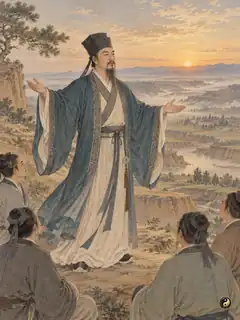
Zhang Zai, courtesy name Zihou, was a native of Chang'an, but because he taught at Hengqu in Mei county he was known as Master Hengqu. As a youth he loved talk of war; at eighteen he wrote to Fan Zhongyan, who told him to read the Doctrine of the Mean, and after years with Buddhist and Daoist texts he returned to the Confucian classics. He passed the metropolitan examination in 1057 and lectured on the Book of Changes, but gave up his tiger-skin seat after talks with his younger relatives Cheng Hao and Cheng Yi. Recommended to court early in the Xining era, he clashed with Wang Anshi and withdrew to Hengqu, where he finished Correcting Youthful Ignorance (Zhengmeng), which explains all things through the gathering and scattering of qi. Recalled in the tenth Xining year, he resigned again over a ritual dispute and died on the road at Lintong. He received the posthumous name Ming in 1220 and a place in the Confucian temple in 1241.
The Western InscriptionSongZhang Zai makes Heaven and Earth our parents and all people our kin
Literature · Sayings1
Unity of Heaven and HumanitySongIdiom from Zhang Zai's Zhengmeng: heaven and humanity as one, people in harmony with nature
Records
Zhang Zai writes the Zhengmeng and Ximing
Northern Song
Zhang Zai, courtesy name Zihou, from Chang'an, studied the ancients and acted on what he learned, becoming a teacher to scholars of Guanzhong and known as Master Hengqu. At twenty-one he wrote to Fan Zhongyan, who urged him to read the Doctrine of the Mean. He lectured on the Changes in the capital seated on a tiger skin, but after the Cheng brothers came and discussed the Changes with him he gave up his seat and stopped lecturing. His book was titled the Zhengmeng, and he also wrote the Ximing; he told his students of the way of knowing ritual, completing nature and changing the temperament.

 Song
 Literature · Rhapsodies