Quanzhen Daoist master from Qixia who, at Genghis Khan's summons, crossed Central Asia to meet him in the Hindu Kush and returned to lead the Daoist clergy of the north
Mural guide
In a temple courtyard at dusk, a great bronze bell hangs at the right and incense smoke rises from a bronze urn; monks in orange robes and plainly dressed visitors walk toward a lamplit hall, lotus flowers bloom in a stone basin, and a gold prayer wheel stands at the left.
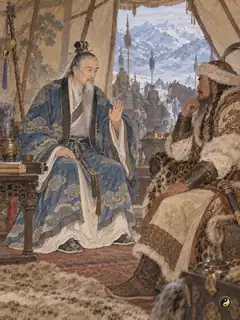
Qiu Chuji, courtesy name Tongmi and Daoist name Master Changchun, came from Qixia in Dengzhou. At nineteen he became a disciple of Wang Chongyang in the Kunyu mountains, one of the seven Quanzhen masters alongside Ma Yu, Tan Chuduan and Liu Chuxuan. He declined summons from both the Jin and the Southern Song courts. In 1219 Genghis Khan sent Liu Zhonglu to fetch him, and he set out from Laizhou with eighteen disciples on a journey of nearly three years to the khan's camp near the Hindu Kush, where he urged reverence for heaven, care for the people, and few desires as the way to long life. Back in Yanjing he was charged by decree with all Daoist affairs and lived in the Taiji Temple until his death in 1227 at the age of eighty. His disciple Li Zhichang wrote the journey up as the Westward Travels of the Perfected Changchun (Changchun zhenren xiyou ji), and his remains lie in the hall now within Beijing's White Cloud Temple.
Answered the summons and traveled west to meet Genghis Khan
1219 to 1227
Qiu Chuji came from Qixia in Dengzhou and at nineteen studied the Quanzhen way under Wang Zhe on Mount Kunyu in Ninghai. Both the Jin and Song courts summoned him, and he declined. In 1219 Genghis Khan sent envoys to call him; he set out west with eighteen disciples and sent a memorial urging an end to killing. He met the khan near the snowy mountains and advised reverence for Heaven, care for the people and a clear mind with few desires. In 1223 he had his disciples restore some twenty to thirty thousand enslaved people to free status. He died in 1227 at eighty.

 Song