
Scholars › Philosopher / Thinker
Fang Xiaoru
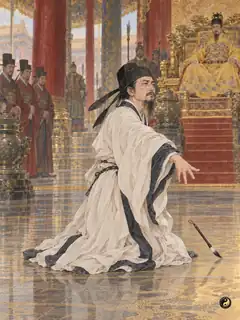
Early Ming scholar and pupil of Song Lian who advised the Jianwen Emperor and was executed in 1402 for refusing to draft Zhu Di's accession edict
A thatched pavilion open on three sides stands among tall bamboo; one person sits with their back turned at the veranda rail beside a zither and a stack of bamboo slips, while a stone path runs to a calm pond reflecting clouds and distant hills.
Also known as Zi Xizhi · Hao Xunzhi · Zi Xigu
Fang Xiaoru, courtesy names Xizhi and Xigu, came from Ninghai and studied under Song Lian, whose older pupils admitted he surpassed them. Recommended to the Hongwu court twice, he became instructor of the Hanzhong prefectural school, and the Prince of Shu, who hired him to teach his heir, named his study Zhengxue, 'right learning'. The Jianwen Emperor made him a Hanlin expositor and consulted him on major policy, and he directed the compilation of the Veritable Records of the founding emperor. When Zhu Di's army took Nanjing in 1402 and ordered him to write the accession edict, he threw down the brush, saying he would die but would not write it; he was executed in the market at forty-six, and his wife and children took their own lives. The story that ten degrees of his kin were wiped out comes from later unofficial histories. The History of Ming (Mingshi) records that in 1585 more than 1,300 descendants still serving as exiled soldiers on his account were released.
Life and times
Dates 1357 CE–1402 CE