
Writers › Writer / Poet
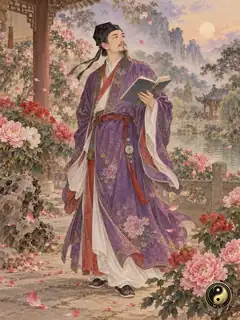
Tang Xianzu
Ming dramatist from Linchuan, banished for criticising the grand secretaries, who left office to write The Peony Pavilion and the other Four Dreams of Linchuan
Mural of The Peony Pavilion, a work by this person.
In a spring garden, a young woman dreams beneath peonies and meets a scholar among falling petals. The pavilion and blossoms hold the longing that carries her dream into life.
Also known as Zi Yireng · Hao Ruoshi · Qingyuan Daoren
- Roles
- Writer / Poet
Tang Xianzu, courtesy name Yireng, styled Ruoshi and the Daoist of Qingyuan, came from Linchuan in Fuzhou, Jiangxi. Known young for his writing, he failed the metropolitan examination repeatedly after refusing to attach himself to the senior grand secretary Zhang Juzheng, and only passed in 1583; he then served in the Court of Imperial Sacrifices in Nanjing and in the Ministry of Rites. In 1591 his memorial attacking the grand secretary Shen Shixing and the censors got him banished as a jail warden at Xuwen in Guangdong, and he later became magistrate of Suichang in Zhejiang. In 1598 he gave up office, returned to Linchuan and finished The Peony Pavilion (Mudan ting) in his Yuming Hall; with The Purple Hairpin, The Southern Bough and The Handan Dream it makes up the Four Dreams of Linchuan. He died at home in 1616, the same year as Shakespeare. In chapter twenty-three of The Story of the Stone, Lin Daiyu is shaken on overhearing lines from The Peony Pavilion.
Life and times
- 1550 CEBorn
 Ming
- 1616 CEDied
Works
 Literature · Drama56
- The Peony PavilionMingTang Xianzu's Ming chuanqi drama: Du Liniang dies of longing and is restored to life by love
- The Peony Pavilion: The Interrupted DreamMing
- The Peony Pavilion: PrologueMing
- The Peony Pavilion: Expressing AmbitionsMing
- The Peony Pavilion: Instructing the DaughterMing
+25 more
- The Peony Pavilion: A Pedant's LamentMing
- The Peony Pavilion: Engaging a TutorMing
- The Peony Pavilion: Melancholy GazingMing
- The Peony Pavilion: The SchoolroomMing
- The Peony Pavilion: Encouraging the FarmersMing
- The Peony Pavilion: Preparing the GardenMing
- The Peony Pavilion: A Mother's WarningMing
- The Peony Pavilion: Pursuing the DreamMing
- The Peony Pavilion: Parting VisitMing
- The Peony Pavilion: The PortraitMing
- The Peony Pavilion: The Spy of the InvadersMing
- The Peony Pavilion: Inquiring into the IllnessMing
- The Peony Pavilion: The Taoist NunMing
- The Peony Pavilion: DiagnosisMing
- The Peony Pavilion: The Bandit WifeMing
- The Peony Pavilion: KeeningMing
- The Peony Pavilion: Audience and EncounterMing
- The Peony Pavilion: A Traveller's LodgingMing
- The Peony Pavilion: Judgment in the UnderworldMing
- The Peony Pavilion: Finding the PortraitMing
- The Peony Pavilion: Remembering the DaughterMing
- The Peony Pavilion: Calling to the PortraitMing
- The Peony Pavilion: The Wandering SoulMing
- The Peony Pavilion: Union in the ShadesMing
- The Peony Pavilion: SuspicionMing
- Open all works→
- Literature · Sayings2
- Brilliant Purples and Lovely RedsMingIdiom from Tang Xianzu's The Peony Pavilion: a riot of blossoms, vivid abundance
- A Fine Hour and a Lovely SceneMingIdiom traced to Xie Lingyun and used in The Peony Pavilion: a fine hour and a lovely scene
- Literature · Prose1
 Stage · Plays1
- The Peony PavilionMing, 1598Tang Xianzu's chuanqi drama of 1598, kept alive on the Kunqu stage through scenes such as The Interrupted Dream