
Writers › Writer / Poet
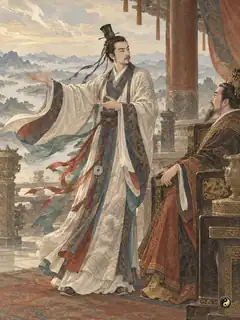
Song Yu
Late Warring States poet of Chu who, the Shiji says, followed Qu Yuan in writing fu, and to whom Wang Yi assigned the Nine Changes in the Songs of Chu
In a study at night, a desk holds a brush pot, a porcelain vase with a plum branch, a lit red lantern, a folded fan and an unrolled blank scroll, with no one seated there, while through a round window the moon rises over a lake with a sailboat.
- Roles
- Writer / Poet
Little is known of Song Yu, a native of Chu in the late Warring States period. The Shiji's biography of Qu Yuan says that after Qu Yuan's death Chu produced Song Yu, Tang Le and Jing Cha, who loved fine words and were known for their fu but copied Qu Yuan's eloquence without daring to remonstrate. In the Eastern Han, Wang Yi's commentary on the Songs of Chu (Chuci) assigned to him the Nine Changes and the Summons of the Soul and called him Qu Yuan's disciple. The History of the Han lists sixteen fu under his name, and the Selections of Refined Literature (Wenxuan) includes the Wind, the Gaotang, the Goddess and other pieces in his name, mostly framed as talks with King Xiang of Chu, their authorship long debated. The saying that the loftier the tune, the fewer join in comes from his Reply to the King of Chu. His dates and fate are unrecorded. Du Fu wrote of understanding Song Yu's grief at autumn's falling leaves.
Life and times
- UnknownBorn
 ZhouChu, late Warring States
- UnknownDied
Works
 Literature · Sayings11
- Lofty Songs Find Few to Join InZhouIdiom from Song Yu's Reply to the King of Chu: lofty work that few can appreciate
- Songs of the Country FolkZhouIdiom from Song Yu's Reply to the King of Chu: popular art, the opposite of highbrow
- Bright Spring and White SnowZhouIdiom from Song Yu's Reply to the King of Chu: refined art beyond popular taste
- The Neighbour's Daughter to the EastZhouLine from Song Yu's rhapsody on Master Dengtu: the eastern neighbour's girl, flawless beauty
- Morning Clouds and Evening Rain on Mount WuZhouIdiom from Song Yu's Gaotang Rhapsody: the goddess of morning clouds and evening rain
+6 more
- Morning Clouds and Evening Rain of the Goddess of Mount WuZhouIdiom from Song Yu's Rhapsody on Gaotang: the goddess who is cloud by day and rain by night
- Every Dawn and Every Dusk Below the Yang TerraceZhouIdiom from Song Yu's Rhapsody on Gaotang: the goddess present morning and evening
- Climbing Hills and Facing Waters: Song Yu's Autumn FarewellZhouIdiom from Song Yu's Nine Changes: autumn sorrow when seeing a traveller home
- Plants and Trees Shake and Fall: Song Yu's Sorrow of AutumnZhouAphorism from Song Yu's Nine Arguments: autumn winds strip the plants and trees
- The King's Mighty WindZhouLine from Song Yu's Rhapsody on the Wind: the king's breeze and the poor man's
- Master Dengtu: How a Slanderer Became a Byword for LecheryZhouFrom the rhapsody on Master Dengtu: a slanderer's name became a word for a lecher
- Literature · Rhapsodies5
- Rhapsody on the WindZhouSong Yu's rhapsody for King Xiang of Chu, dividing the wind into the king's and the commoner's
- Rhapsody on Master Dengtu the LecherZhouSong Yu's witty defence against a charge of lust, turning the accusation on his accuser
- Rhapsody on the Divine MaidenZhouSong Yu's sequel to the Gaotang rhapsody, portraying the goddess of Mount Wu, lovely and aloof
- Rhapsody on GaotangZhouSong Yu's rhapsody of a Chu king's dream of the Wushan goddess, source of 'clouds and rain'
- Summoning the SoulZhouThe summons credited by tradition to Song Yu: horrors of the four quarters, joys of home
- Literature · Fables1
- The Loftier the Song, the Fewer Who Join InZhouSong Yu's image in his Reply to the King of Chu: the loftier the tune, the fewer who join in
- Literature · Poetry1
- Nine Arguments · ExcerptZhouSong Yu's Chu-style sequence on autumn and a scholar's lost post, root of the autumn lament
- Literature · Prose1
- Reply to the King of ChuZhouSong Yu's reply to King Xiang of Chu, defending himself with refined songs, phoenix and kun