Western Han scholar of the Gongyang Commentary whose policy answers to Emperor Wu urged the court to favour Confucian learning over all other schools
Mural guide
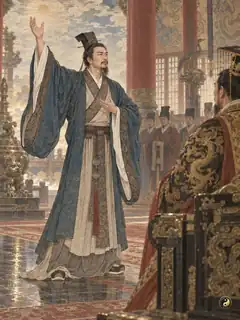
Mural of the event “State-Sanctioned Confucianism”, which this person took part in.
After Emperor Wu's ascension, the unified empire required a matching state ideology to replace passive Huang-Lao governance and definitively consolidate centralized institutions. The court needed a single ideological pillar.
Dong Zhongshu came from Guangchuan (modern Jing County, Hebei) and studied the Gongyang tradition of the Spring and Autumn Annals, becoming an Erudite under Emperor Jing; he is said to have taught behind a curtain for three years without glancing at his garden. Answering Emperor Wu's call for men of worth, he submitted three policy essays, arguing that teachings outside the six classics and the way of Confucius should be cut off. He then served as chancellor to Liu Fei, King of Jiangdu, but his private essay reading omens into a fire at the Liaodong ancestral temple was stolen by Zhufu Yan and shown to the emperor, and he was condemned to death before being pardoned. Later chancellor of Jiaoxi, he retired to write, and on major questions the court sent Zhang Tang to consult him at home. The History of the Han lists essays such as Luxuriant Dew, which gave its name to the surviving Chunqiu fanlu, and quotes Liu Xiang calling him fit to assist a king.
134 BCEState-Sanctioned ConfucianismTook partConfucian learning gained stature in court education and politics under Emperor Wu; the formula “reject the hundred schools, honor Confucianism alone” is a later summary, not a contemporary edict.
Tui'en Decree and Confucian Orthodoxy127 BCEEmperor Wu enacted the Decree of Extending Grace to fragment vassal realms and adopted Confucianism as the sole state orthodoxy.
Dong Zhongshu and the Six Arts and Confucius's way
Western Han period
The Book of Han biography says Dong Zhongshu came from Guangchuan, studied the Spring and Autumn Annals in his youth, and became an erudite under Emperor Jing. He taught behind a lowered curtain, with pupils passing the lessons on in order of seniority, so that some never saw his face, and he did not look at his garden for three years. In his answers to the throne he held that whatever lay outside the Six Arts and the way of Confucius should have its path cut off and not be allowed to advance alongside. When the answers were finished the emperor made him chancellor of Jiangdu under Prince Yi. He also discussed the gains and losses shown in the Annals in writings such as Wenju, Jade Cup, Luxuriant Dew, Clear Brightness and Bamboo Grove, all handed down to later ages.

 Han

 Literature · Prose
