
Royals › Monarch / Emperor
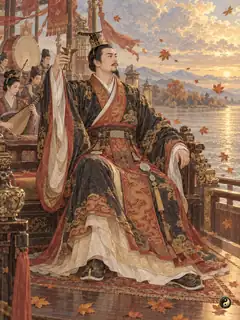
Emperor Wu of Han (Liu Che)
Western Han emperor for fifty-four years who began the use of reign titles, sent armies against the Xiongnu and envoys to Central Asia, and weakened the princes
Mural of the event “State-Sanctioned Confucianism”, which this person took part in.
After Emperor Wu's ascension, the unified empire required a matching state ideology to replace passive Huang-Lao governance and definitively consolidate centralized institutions. The court needed a single ideological pillar.
Also known as Liu Che
- Roles
- Monarch / Emperor
Liu Che, Emperor Wu of Han, was the son of Emperor Jing. He came to the throne in 141 BC and from the next year used the reign title Jianyuan, followed by Yuanshuo, Yuanshou, Taichu and others. In 127 BC he adopted Zhufu Yan's Edict of Grace, dividing princedoms among all heirs, and he later created thirteen regional inspectorates. His generals Wei Qing and Huo Qubing campaigned against the Xiongnu, driving them north after the battle of Mobei in 119 BC; he also sent Zhang Qian to Central Asia, conquered Nanyue and created commanderies in the Hexi corridor. At home he created posts for scholars of the Five Classics on Dong Zhongshu's advice, imposed state monopolies on salt and iron, issued the wuzhu coin and adopted the Taichu calendar in 104 BC. He died at the Wuzuo Palace in 87 BC and was buried at Maoling. The History of the Han (Hanshu) credits him with great talent and bold plans, yet also records his late Luntai edict halting expansion westward.
Life and times
- 156 BCEBorn
 Han
- 138 BCEZhang Qian's Mission
 In powerage 18Zhang Qian's missions brought Central Asian geography and politics to the Han court, enabling sustained engagement along the emerging Silk Roads.
- Zhang Qian's First Western MissionIn 138 BCE, Zhang Qian was commissioned by Emperor Wu of Han to seek the Yuezhi, beginning a new phase of Han engagement with the Western Regions.
- Opening of the Silk RoadZhang Qian's Epic Diplomatic Mission Piercing the Western Regions
- Zhang Qian's First Western Mission
- 134 BCEState-Sanctioned Confucianism
 Took partage 22Confucian learning gained stature in court education and politics under Emperor Wu; the formula “reject the hundred schools, honor Confucianism alone” is a later summary, not a contemporary edict.
- Tui'en Decree and Confucian Orthodoxy127 BCEage 29Emperor Wu enacted the Decree of Extending Grace to fragment vassal realms and adopted Confucianism as the sole state orthodoxy.
- Tui'en Decree and Confucian Orthodoxy
- 129 BCEXiongnu Campaigns
 In powerage 27The thunder northern campaigns that turned Han from strategic defense to strategic offense.
- Han Ambush at Mayi Fails133 BCEage 23Emperor Wu laid an ambush near Mayi to lure the Chanyu, who turned back on discovering it; the Xiongnu then broke off heqin relations.
- Su Wu's Captivity Among the Xiongnuc. 100 BCEage 56Sent as envoy to the Xiongnu, Su Wu was detained, herded sheep by the Northern Sea without submitting, and returned to Han after nineteen years.
- Han Ambush at Mayi Fails
- 121 BCEHuo Qubing Receives the Hunye Surrender
 age 35Huo Qubing crossed the river to secure the Hunye king's surrender, suppressed wavering factions, and escorted tens of thousands into Han territory.
- 110 BCEHan Wudi's Mount Tai Summit
 Took partage 46Ascending Mount Tai to declare cosmic peace, cementing the paramount imperial ritual liturgy of China.
- Han Wudi Fengshan at Dai TempleEmperor Wu of Han performed the Fengshan sacrifices and expanded the base ceremonial grounds, establishing the earliest layout of Dai Temple.
- Emperor Wu Fengshan at Mount TaiEmperor Wu performed grand Fengshan imperial rites at Mount Tai, celebrating Western Han apex.
- Han Wudi Fengshan at Dai Temple
- 104 BCECompiling the Shiji
 In powerage 52Sima Qian organized the Shiji into annals, tables, treatises, houses, and biographies spanning legendary antiquity through the Han.
- Li Ling Surrenders; Sima Qian Punishedc. 99 BCEage 57Li Ling surrendered to the Xiongnu after his defeat at Mount Junji, and Sima Qian, who spoke in his defence, was imprisoned and sentenced to castration.
- Li Ling Surrenders; Sima Qian Punished
- 87 BCEDied
- 81 BCEDiscourse on Salt and Iron
 PrecursorNational summit on state monopolies vs private markets, defining 2,000 years of imperial economic doctrine.
- Han Salt-Iron Offices at Yandu119 BCEage 37In 119 BCE, Han authorities established salt-and-iron offices and Yandu County, strengthening state management of production and circulation.
- Han Salt-Iron Offices at Yandu
Works
 Literature · Poetry3
- Song of the Autumn WindHanChu-style song ascribed to Emperor Wu of Han, sailing the Fen River after rites at Hedong
- Song for Lady Li (Is It She or Not)HanEmperor Wu's brief song for Lady Li, glimpsed through a curtain during a medium's seance
- Songs of the Huzi BreachHanEmperor Wu's two Chu songs at the Yellow River breach, as his officials carried brushwood
- Literature · Sayings2
- Joy at Its Height Turns to SorrowHanIdiom echoing Emperor Wu's Autumn Wind: at joy's height, sorrow swells
- So Slow, So Late: Emperor Wu Waits for Lady Li's SpiritHanIdiom from Emperor Wu's song for Lady Li: so slow in coming, so late
- Literature · Rhapsodies1
- Rhapsody Mourning Lady LiHanEmperor Wu of Han mourns Lady Li, recalling her beauty and promising to keep faith with her
Family tree
- Direct kinFatherMother
 Emperor Wu of Han (Liu Che)

Connections
Shared events11Sima Qian, Huan Kuan, Sang Hongyang …
- Rulers and officials7


