
Writers › Writer / Poet
Sima Xiangru
Western Han rhapsody writer whose Sir Vacuous and Shanglin Park fu won over Emperor Wu, and who eloped with the widow Zhuo Wenjun
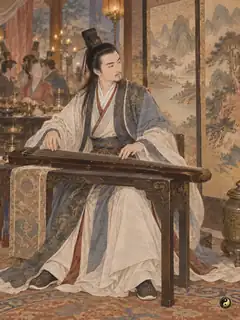
Mural of the event “Wenjun at Wine Shop”, which this person took part in.
Set in Shu during the Western Han, the story of Zhuo Wenjun and Sima Xiangru moves from musical courtship and elopement to their shared livelihood in Linqiong, followed by the themes of love and self-respect preserved in later literary tradition.
Also known as Zi Zhangqing · Fu Sheng · Si Ma Zhang Qing
- Roles
- Writer / Poet
Sima Xiangru, courtesy name Zhangqing, came from Chengdu in Shu; called Quanzi as a boy, he renamed himself after Lin Xiangru. He served Emperor Jing as a mounted guard, then left on grounds of illness to join the circle of Prince Xiao of Liang, where he wrote the Sir Vacuous Rhapsody (Zixu fu). According to his biography in the Records of the Grand Historian (Shiji), after returning to Shu he won over Zhuo Wenjun, the widowed daughter of the Linqiong magnate Zhuo Wangsun, with his zither playing; they eloped to Chengdu and later ran a wine shop in Linqiong. Emperor Wu read the Zixu fu, summoned him and received the Shanglin Park Rhapsody, making him a gentleman of the palace, and later sent him as an envoy to pacify the southwestern peoples. He ended as keeper of Emperor Wen's funerary park and died at home in Maoling, leaving a text on the feng and shan sacrifices. The bibliography of the History of the Han lists twenty-nine of his rhapsodies.
Life and times
- c. 179 BCEBorn
 Han
- 150 BCEWenjun at Wine Shop
 Took partZhuo Wenjun eloped with Sima Xiangru, ran a tavern in Linqiong, and authored the immortal Song of White Hair.
- Zhuo Wenjun Elopement with Sima XiangruWooed by the zither piece Phoenix Courting, Wenjun eloped in the night to pursue authentic love.
- Tavern Keeping in Linqiong142 BCEOpening a wine tavern in Linqiong, Wenjun stood at the counter while Xiangru washed vessels in the market.
- Song of White Hair Severance Letter130 BCEComposing Song of White Hair with 'May I win a person's heart, till our hair turns white', preserving mutual dignity.
- Zhuo Wenjun Elopement with Sima Xiangru
- 118 BCEDied
- 110 BCEHan Wudi's Mount Tai Summit
 PrecursorAscending Mount Tai to declare cosmic peace, cementing the paramount imperial ritual liturgy of China.
Works
 Literature · Sayings19
- Duty Forbids Looking BackHanIdiom from Sima Xiangru's proclamation to Ba and Shu: frontier men who never turned back
- Standing Third with Heaven and EarthHanIdiom from Sima Xiangru's Rebuttal to the Elders of Shu: a ruler's vision as vast as the cosmos
- A Rich Man Never Sits Under the EavesHanIdiom from Sima Xiangru's warning against the hunt: never sit where danger lurks
- Sir Fictitious and Master Nobody: Sima Xiangru's Invented DebatersHanIdiom from Sima Xiangru's rhapsody: invented speakers whose names mean 'nobody'
- So Near Her Room, So Far the Lady: The Phoenix Seeks His MateHanIdiom from the zither song ascribed to Sima Xiangru: her room so near, she so far
+14 more
- Little Integrity, Less Shame: Sima Xiangru's Proclamation to Ba and ShuHanIdiom from Sima Xiangru's proclamation to Ba and Shu: lacking integrity and shame
- Lofty Counsel and Broad Vision: Sima Xiangru Answers the Elders of ShuHanIdiom from Sima Xiangru's reply to the elders of Shu: lofty, far-sighted counsel
- Reciting What Has Been Handed DownHanIdiom from Sima Xiangru's Rebuttal to the Elders of Shu: no mere repeating of the past
- This Is a Matter of Great MomentHanIdiom from Sima Xiangru's Rebuttal to the Elders of Shu: a matter of great weight
- Deep Grace Overflowing from the Han ThroneHanIdiom from Sima Xiangru's reply to the Shu elders: imperial grace deep and overflowing
- Moth Brows and Gleaming Teeth: the Neighbour in Sima Xiangru's RhapsodyHanIdiom from the Rhapsody on a Beauty: the girl next door with moth brows and white teeth
- Accidents of Bit and Bridle: Sima Xiangru Remonstrates Against the HuntHanIdiom from Sima Xiangru's memorial against the hunt: mishaps lurk even on cleared roads
- Resolved Without Turning on One's Heel: Sima Xiangru's Proclamation to Ba and ShuHanIdiom from Sima Xiangru's Proclamation to Ba and Shu: frontier soldiers who never turn back
- Planning Deeply and Looking Far Ahead: Sima Xiangru on Loyal ServiceHanIdiom from Sima Xiangru's Proclamation to Ba and Shu: soldiers who think far ahead
- Turning Thoughts Over and ReconsideringHanIdiom from Sima Xiangru's essay on the Feng and Shan rites: the emperor thinks it over
- Far and Near United as One BodyHanIdiom from Sima Xiangru's reply to the elders of Shu: far and near joined as one
- Fleeing Drowning to a Mountain CornerHanIdiom from the Rhapsody on Beauty: avoiding a temptation one has never met
- Gathering Like Fish Swimming UpstreamHanIdiom from Sima Xiangru's reply to the elders of Shu: distant rulers flock to the Han
- A Rich Man Does Not Sit Beneath the EavesHanIdiom from Sima Xiangru's memorial against the hunt: the wealthy avoid the falling tile
- Literature · Rhapsodies6
- Rhapsody of Master VoidHanSima Xiangru's grand rhapsody of three invented speakers boasting of Chu and Qi hunting parks
- Rhapsody on the Imperial Shanglin ParkHanSima Xiangru's sequel to Master Void, extolling the emperor's park only to counsel restraint
- Rhapsody on the Long Gate PalaceHanPalace lament ascribed to Sima Xiangru for the neglected Empress Chen and her long nights alone
- Rhapsody on the Great ManHanSima Xiangru's late rhapsody of a cosmic journey, meant to curb Emperor Wu's quest for eternity
- Lament for the Second Emperor of QinHanSima Xiangru's short sao-style rhapsody at the tomb of the Second Emperor, a lesson from Qin
+1 more
- Rhapsody on a BeautyHanRhapsody ascribed to Sima Xiangru, modelled on Song Yu: resisting a beauty's advances
- Literature · Prose4
- Proclamation to Ba and ShuHanSima Xiangru's proclamation calming Ba and Shu for Emperor Wu, mixing reassurance and threat
- Rebuttal to the Elders of ShuHanSima Xiangru's set debate with imagined Shu elders, defending the opening of the southwest
- Memorial Remonstrating against the HuntHanSima Xiangru's memorial warning Emperor Wu not to risk his life fighting beasts on the hunt
- Essay on the Feng and Shan SacrificesHanSima Xiangru's last work, praising Han virtue and urging Emperor Wu to the feng and shan rites
- Literature · Poetry1
- Two Qin Songs (The Phoenix Seeks His Mate)HanTwo qin songs said to be Sima Xiangru's serenade to Zhuo Wenjun, first found in Yutai Xinyong
Family tree
- Direct kin
 Sima XiangruWife
- Other kin1


