
Writers › Writer / Poet
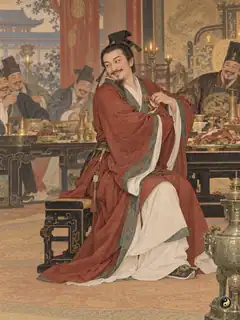
Dongfang Shuo
Western Han courtier and writer at Emperor Wu's court, remembered for his wit, his remonstrances and the essay Replying to a Guest's Objections
In a study at night, a desk holds a brush pot, a porcelain vase with a plum branch, a lit red lantern, a folded fan and an unrolled blank scroll, with no one seated there, while through a round window the moon rises over a lake with a sailboat.
Also known as Zi Manqian · Dong Fang Man Qian
- Roles
- Writer / Poet
Dongfang Shuo, courtesy name Manqian, came from Yanci in Pingyuan. When Emperor Wu, newly enthroned, called for talented men, he submitted a memorial on three thousand wooden slips that took the emperor two months to read, and was kept at court awaiting appointment, first at the public carriage office and later at the Golden Horse Gate, at one point serving as palace counsellor. In 138 BC he argued against enlarging the Shanglin hunting park; the emperor rewarded him with gold but built the park anyway. He used jokes and banquet banter to slip criticism past the throne, and a long memorial on strengthening the state through farming and war went unused, so he wrote Replying to a Guest's Objections (Da ke nan) and the Discourse of Master Nonexistent on the frustrations of an unrecognized talent. The Book of Han (Hanshu) notes that tales of his jests and guessing games circulated among common people, and that later storytellers attached all manner of strange sayings to his name.
Life and times
Dates c. 154 BCE–c. 93 BCE