
Makers › Scientist
Zhang Heng
Eastern Han scholar and poet who twice served as grand astrologer, built a water-driven armillary sphere and a seismoscope, and spent ten years on his Two Capitals rhapsodies
On an observatory terrace at night, a large bronze armillary sphere stands on a stone base while two people stand with their backs turned facing the view; stars are joined into constellation lines overhead, and a sundial and tiered dripping water vessels stand at the right.
Also known as Zi Pingzi · Zhang Ping Zi
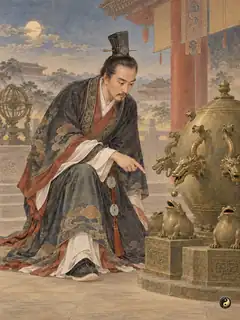
Zhang Heng, courtesy name Pingzi, came from Xi'e in Nanyang. He studied at the Imperial Academy in Luoyang but declined to seek office. His Rhapsodies on the Two Capitals (Er jing fu), a veiled rebuke of noble extravagance modelled on Ban Gu, took him ten years. Summoned to court under Emperor An, he twice served as grand astrologer, built a water-powered armillary sphere and expounded the theory of a spherical heaven in The Spiritual Constitution of the Universe (Lingxian). In 132 he made his seismoscope; the Book of Later Han (Hou Hanshu) says it once registered a tremor no one in the capital had felt, and days later a courier reported an earthquake in Longxi. He later served as chancellor of Hejian, curbing local strongmen, and returned to court as a secretary before his death in 139. His "Rhapsody on Returning to the Fields" is usually dated to his last years. A crater on the far side of the Moon bears his name.
Life and times
Dates 78 CE–139 CE