Tang monk who travelled overland to India for Buddhist scriptures, returned in 645 with 657 texts, and translated 75 works in 1,335 scrolls
Mural guide
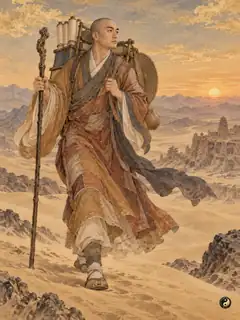
Mural of the event “Xuanzang's Western Pilgrimage”, which this person took part in.
In early Tang, Buddhist scripture translations existed in many versions with constant doctrinal disputes. The young monk Xuanzang deeply felt that only by personally going to Buddhism's birthplace India to seek scriptures and the dharma could the foundational theoretical difficulties of Chinese Buddhism be solved.
Xuanzang, born Chen Yi in Goushi in Luozhou, became a monk as a boy at the Jingtu monastery in Luoyang. Troubled by conflicting readings of the scriptures, he resolved to find the originals in India, and according to his biography by Huili he left without permission in 629 (some sources say 627), crossing Gaochang and the Western Regions to the monastery of Nalanda, where he studied the *Yogacarabhumi* under Silabhadra. He returned to Chang'an in 645 with 657 Sanskrit texts, and Emperor Taizong set him to head translation teams at the Hongfu and later the Great Ci'en monasteries. He dictated the *Great Tang Record of the Western Regions* (*Da Tang xiyu ji*), twelve chapters on more than a hundred countries, to his disciple Bianji and in all translated 75 works in 1,335 scrolls. He died at the Yuhua monastery in early 664 and was later reburied in a pagoda at the Xingjiao monastery. The Ming novel *Journey to the West* (*Xiyou ji*) is built on his pilgrimage.
627Xuanzang's Western PilgrimageTook partXuanzang crossed Central Asia to study in India, returned to Chang'an with Sanskrit texts, and led a major translation program.
Xuanzang Teaches at GaochangDuring his westward journey in 627, Xuanzang was received and pressed to remain by Gaochang's king, taught for about a month, and then continued west.
Xuanzang Returns to Chang'an to Translate645In 645 Xuanzang returned to Chang'an with Sanskrit texts and then led a major translation program that brought the journey's materials into Tang Buddhist scholarship.
Ordained and translating at Hongfu and Ci'en temples
From 645
The Old Book of Tang says Xuanzang took monastic vows in the last Daye years and read widely in the sutras and treatises. After he returned to the capital, an edict ordered his 657 Sanskrit texts to be translated at Hongfu Temple, and Fang Xuanling and others were told to call in more than fifty learned monks to help. While Gaozong was in the palace, he had built Ci'en Temple and a translation hall in memory of Empress Wende, and had sent Xuanzang to live there with the translated scriptures and images.
Seventeen years in the Western Regions and the Xiyu ji
Early Zhenguan to 645
The Old Book of Tang says the monk Xuanzang, surnamed Chen, of Yanshi in Luozhou, went to the Western Regions with merchants in the early Zhenguan years. He spent seventeen years there, passing through over a hundred countries, came to understand their languages, and recorded their landscapes, customs and products in the Xiyu ji in twelve chapters. In 645, the nineteenth year of Zhenguan, he returned to the capital.

 Sui
 Tang

 Literature · Prose

