Tang Chan monk from Xinzhou in the far south who received the robe of the Fifth Patriarch Hongren and taught sudden awakening at Caoxi; his sermons were recorded as the Platform Sutra
Mural guide
A thatched pavilion open on three sides stands among tall bamboo; one person sits with their back turned at the veranda rail beside a zither and a stack of bamboo slips, while a stone path runs to a calm pond reflecting clouds and distant hills.
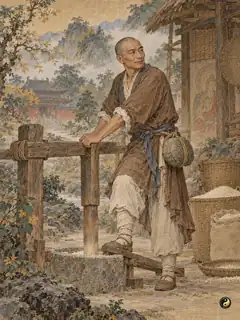
Huineng was surnamed Lu; his father, an official demoted to the far south, settled in Xinzhou, where Huineng was born in 638. The Platform Sutra says he sold firewood to support his mother, was struck by hearing the Diamond Sutra recited, and went north to Hongren, the Fifth Patriarch, at Huangmei, where he pounded rice for over eight months and won the robe and teaching with a verse declaring that bodhi has no tree. In 676 at Faxing Temple in Guangzhou he settled a dispute over whether the wind or the banner moved by saying it was the mind, and the monk Yinzong ordained him. He then taught for more than thirty years at Baolin Temple in Caoxi, Shaozhou, and died at Guoen Temple in Xinzhou in 713. In 815 Emperor Xianzong named him Chan Master Dajian. His disciple Fahai compiled the Platform Sutra (Tanjing), Shenhui argued for his Southern school at the Huatai assembly, and his preserved body is kept at Nanhua Temple.
The Song Biographies of Eminent Monks says the monk Huineng, surnamed Lu, was from Xinxing in Nanhai. He went to the grand assembly where Dharma Master Yinzong was lecturing on the Nirvana Sutra in Nanhai; in the talk about the wind and the banner Yinzong yielded in argument and bowed in spirit, and Huineng's topknot was cut off at Faxing Temple, after which he received the full precepts from the Vinaya master Zhiguang. Emperor Xianzong later posthumously named him Dajian and named his stupa Yuanhe Zhengzhen.

 Tang
 Literature · Poetry