Late Tang and Five Dynasties master Buddhist poet (863–937 CE), one of the most prolific poets in the Complete Tang Poems, famous for the 'One Word Master' anecdote.
Mural guide
In a temple courtyard at dusk, a great bronze bell hangs at the right and incense smoke rises from a bronze urn; monks in orange robes and plainly dressed visitors walk toward a lamplit hall, lotus flowers bloom in a stone basin, and a gold prayer wheel stands at the left.
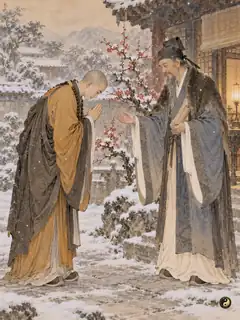
Qi Ji (863–937 CE), lay name Hu Desheng, was a preeminent Buddhist poet of the Late Tang and Five Dynasties, serving as Monastic Rector in Jingnan. Author of over 800 surviving poems in the Quan Tang Shi, his humble deference to Zheng Gu over a single character in his poem 'Early Plum Blossoms' founded the revered concept of the 'One Word Master' (Yi Zi Shi).
The SwordsmanTangMonk Qiji's quatrain of a swordsman going out into the snow to repay a debt of kindness
Literature · Sayings1
Teacher of a Single WordTangIdiom from Zheng Gu's one-word fix to Qiji's Early Plum: a teacher for one word
Records
Author of the Bailian ji, who called himself a monk of Mount Heng
Jingnan, Five Dynasties
The Song Biographies of Eminent Monks says Qiji was devoted to chanting poetry, with a clear and mild tone, and exchanged poems with the Mount Hua recluse Zheng Gu; in 921 he was lodged in the pure courtyard of Longxing Temple at Jiangling. He left a Bailian ji that circulated in the world and styled himself a monk of Mount Heng.
The Song Biographies of Eminent Monks says the monk Qiji, surnamed Hu, was a native of Yiyang who entered Dawei Temple as a child, later joined the Shishuang assembly and went on to study at Yaoshan, Lumen and Huguo monasteries. After the Gao family took power in the region it gave him a monthly stipend and made him monk-superintendent, though this was not to his liking.

 Tang
 Five Dynasties and Ten Kingdoms
 Literature · Poetry