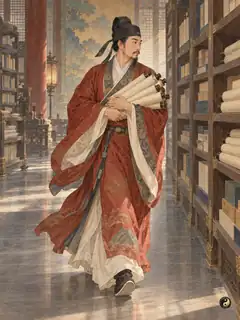
Early Tang historian who completed his father's project as the History of the Southern Dynasties and History of the Northern Dynasties.
Mural guide
In an archive hall, tall wooden shelves hold scrolls and bound books with small tags, and one person climbs a ladder with their back turned; a long table in front holds an unrolled river map, a bronze lamp and a copper jug, with a city wall seen through the window.
Li Yanshou, courtesy name Xialing, from Xiangzhou, served at the Tang court during the Zhenguan era and took part in compiling the official histories of the Sui and Jin. Carrying on his father Li Dashi's plan, he spent sixteen years condensing and supplementing earlier histories and in 659 submitted the History of the Southern Dynasties (80 chapters) and History of the Northern Dynasties (100 chapters). Both are among the Twenty-Four Histories, and idioms such as 'two eagles with one arrow' appear in them.
Life and times
UnknownBornTangactive under Tang Taizong and Gaozong (c. 627–659 CE)
UnknownDied
Works
Literature · Sayings2
One Arrow, Two EaglesTangIdiom from the History of the Northern Dynasties: two aims achieved with one act
Two Eagles with One ArrowTangEpisode in the History of the Northern Dynasties: Zhangsun Sheng downs two eagles at once
Records
Li Yanshou's Court Posts
From the Zhenguan years
During the Zhenguan years Li Yanshou was appointed in turn steward of the Crown Prince's table and scholar of the Chongxian Institute. Soon after, he became clerk in the Censorate while serving on duty for the national history, and he later rose to master of the imperial seals, still working on the national history.
Li Yanshou compiles the Southern and Northern Histories
Early Tang
Li Yanshou was once ordered, with the assistant editor Jing Bo, to compile the Treatises of the Five Dynasties, and he also took part in writing the Jinshu. He further abridged and supplemented the histories of eight dynasties, Song, Qi, Liang and Chen, and Wei, Qi, Zhou and Sui, and called the result the Southern and Northern Histories, in 180 fascicles, which circulated widely in his day.

 Tang
 Literature · Sayings