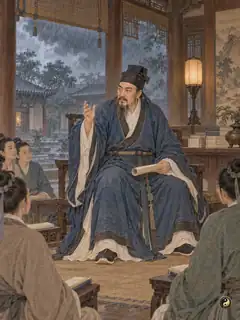
Also known as Zi Shushi · Hao Jingyang · Master of the Eastern Grove · Duanwen (posthumous name)
Gu Xiancheng, courtesy name Shushi, sobriquet Jingyang, was a Wuxi native who passed the palace examination in 1580. As director of the selection bureau in the Ministry of Personnel he nominated Wang Jiaping for the Grand Secretariat against the Wanli Emperor's wishes and was stripped of office. In 1604, with his younger brother Gu Yuncheng, Gao Panlong and others, he rebuilt the Donglin Academy where the Song scholar Yang Shi had taught; its lectures mixed philosophy with criticism of court policy and officials, drawing wide support, and opponents labelled its circle the Donglin faction. He died at home in 1612 and was later honoured as Duanwen. He did not live to see the Tianqi purges, but he founded the movement they targeted, and the academy itself was ordered torn down in 1625.
Records
From revenue secretary to head of the appointments bureau
From 1580, in the Wanli periodThe Ming History says Gu Xiancheng placed first in the provincial examination in 1576 and took the jinshi degree in 1580, and was made secretary in the Ministry of Revenue. He was moved to the Ministry of Personnel, then demoted to assistant magistrate of Guiyang, rose to judge at Chuzhou and Quanzhou, was raised to secretary in the merit bureau, served as vice director and became head of the appointments bureau. He recommended the former grand secretary Wang Jiaping against the emperor's wishes and was struck from the rolls and sent home.
References (1)
- 明史/卷231 · Wikisource (Chinese)
Restored the Donglin Academy and lectured there
In the Wanli period, after he was struck from the rollsThe Ming History says that the old Donglin Academy at Wuxi, where Yang Shi of the Song had taught, was restored on the proposal of Gu Xiancheng and his brother Yuncheng, and that when it was finished he lectured there with Gao Panlong, Qian Yiben and others. He had set his heart on the sages' learning from childhood, and after being struck from the rolls and living at home he studied still more closely and strongly opposed Wang Shouren's saying that the mind in itself has neither good nor evil.
References (1)
- 明史/卷231 · Wikisource (Chinese)