Neo-Confucian thinker and Donglin leader who taught at the Donglin Academy, rose to Chief Censor and drowned himself rather than face arrest by Wei Zhongxian's faction.
Mural guide
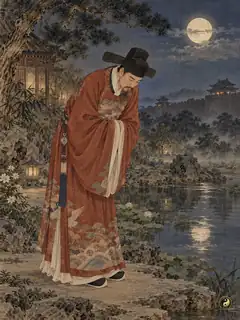
Mural of the event “Purge of the Donglin Faction”, which this person took part in.
Under the Tianqi Emperor (1624–1627) the eunuch Wei Zhongxian and Madam Ke dominated the court; Donglin officials such as Yang Lian and Zuo Guangdou died in the imperial prison, and Zhou Shunchang's arrest in Suzhou set off a townspeople's revolt. After the Chongzhen Emperor's accession Wei hanged himself, and in 1629 the court proclaimed the Traitors' Case.
Gao Panlong, courtesy name Cunzhi, sobriquet Jingyi, was a Wuxi native who passed the palace examination in 1589. With Gu Xiancheng he revived the Donglin Academy, and his rigorous practice made him a leading Confucian of his day, the pair being spoken of together as Gao and Gu. Under the Tianqi Emperor he rose to Chief Censor and exposed the corrupt censor Cui Chengxiu, who then joined Wei Zhongxian and had Gao stripped of rank. In 1626, when imperial guards came to arrest him, he left a memorial saying that a minister's humiliation shames the state, put on his court dress and drowned himself in a pond, aged sixty-five by Chinese reckoning. He was posthumously honoured as Zhongxian under Chongzhen, a Donglin leader who died in the purge.
1624Purge of the Donglin FactionTook partage 62Under the Tianqi Emperor the eunuch Wei Zhongxian and Madam Ke dominated the court; after Yang Lian's memorial of twenty-four crimes, Donglin officials were dismissed and died in prison until the Chongzhen Emperor's accession brought Wei's fall and suicide.
The Ming History says Gao Panlong took the jinshi degree in 1589 and was made a messenger official. He memorialized to refute Zhang Shize's Daxue chuyi, and the book did not circulate; he also wrote on the dismissal of Li Shida, Zhao Yongxian and others and was demoted to supplementary clerk at Jieyang. Early in the Tianqi reign he was called back as an aide in the Court of Imperial Entertainments, rose to its vice director and then became chief minister of the Court of the Imperial Stud. He impeached the imperial in-law Zheng Yangxing and urged that Fang Congzhe be punished, was named Censor-in-Chief in 1624, exposed Cui Chengxiu's misdeeds, and was struck from the rolls after Cui's counterattack.
Followed the Cheng-Zhu school and lectured at Donglin
In the Wanli and Tianqi periods, Ming
The Ming History says Gao Panlong, from his early reading, aimed at the Cheng-Zhu school. He lectured with Gu Xiancheng at the Donglin Academy, with stillness as the center, and was called the leading Confucian of his time. Early in the Chongzhen reign he was posthumously given the titles of junior guardian of the heir and minister of war, and the posthumous name Zhongxian.

 Ming

 Literature · Prose

