Tang monk and disciple of Xuanzang who wrote the first five juan of the Biography of the Tripitaka Master of Da Ci'en Monastery.
Mural guide
In a temple courtyard at dusk, a great bronze bell hangs at the right and incense smoke rises from a bronze urn; monks in orange robes and plainly dressed visitors walk toward a lamplit hall, lotus flowers bloom in a stone basin, and a gold prayer wheel stands at the left.
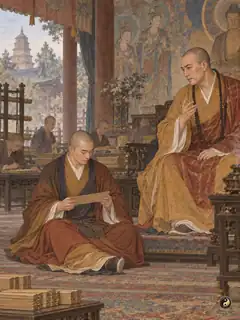
Huili, originally named Zili and renamed Huili by Emperor Gaozong, was a native of Tianshui with the lay surname Zhao. Ordained at fifteen in 629, he joined Xuanzang's translation bureau and later served as rector of Ximing Monastery and abbot of Taiyuan Monastery. He wrote a five-juan account of Xuanzang's life; the Song Biographies of Eminent Monks says that, fearing it incomplete, he hid it in a cellar and had his disciples dig it out only as he was dying. In 688 the monk Yancong annotated and extended it to ten juan as the Biography of the Tripitaka Master of Da Ci'en Monastery, the principal source for Xuanzang's pilgrimage and translation work.
Life and times
UnknownBornSuiTangb. 615; death date unknown, before 688
Left household life at fifteen and held monastery posts
629
Huili, originally named Zili, came from Tianshui and had the lay surname Zhao. He left household life in 629 at the age of fifteen and lived at Zhaoren Monastery in Bin Prefecture. He was later summoned by imperial order to serve as Great Virtue of Sutra Translation at Daci'en Monastery, was then appointed Supervisor of Monks at Ximing Monastery, and was afterwards made abbot of Taiyuan Monastery, each time by imperial decree.
Wrote the Record of the Deeds of the Tripitaka Master of Ci'en
Tang
Huili held that, without an account, later ages would hear little of Xuanzang's journey to India for scriptures, so he wrote the Record of the Deeds of the Tripitaka Master of Ci'en, but he died before it was finished. Yancong, a monk of Guangfu Monastery, later completed it in ten chapters. After finishing his draft Huili feared he had left things out and hid it underground, then ordered his attendants to dig it up as he was dying.

 Sui
 Tang
 Literature · Prose