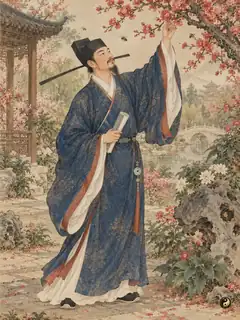
Northern Song scholar-official who wrote the biographies of the New Tang History and whose line on red apricot blossoms earned him the nickname Red Apricot Minister
Mural guide
In a study at night, a desk holds a brush pot, a porcelain vase with a plum branch, a lit red lantern, a folded fan and an unrolled blank scroll, with no one seated there, while through a round window the moon rises over a lake with a sailboat.
Song Qi, courtesy name Zijing, came from an Anlu family that had moved to Yongqiu near Kaifeng, and in 1024 he sat the examinations with his elder brother Song Xiang. The Ministry of Rites ranked Song Qi first and his brother third, but Empress Dowager Zhangxian held that a younger brother should not precede an elder, so Song Xiang was made top graduate and Song Qi dropped to tenth; the pair became known as the Two Songs. Working beside Ouyang Xiu on the New Tang History (Xin Tang shu), he wrote its biographies over more than ten years. He rose to minister of works and chief Hanlin academician, died in 1061, and was named Jingwen. His lyric line about spring bustling on a branch of red apricot blossom earned him, Song anecdotes say, the nickname Red Apricot Minister, and Wang Guowei's Remarks on Lyrics in the Human World (Renjian cihua) said the single word for bustling brings the whole scene to life.
Song Qi, courtesy name Zijing, sat the jinshi examination together with his elder brother Song Xiang, and the Ministry of Rites reported him first. He worked on the Tang history for more than ten years; when it was finished he was promoted to Left Assistant Director and then Minister of Works, and afterwards named Hanlin Academician Recipient of Edicts.
Song Qi and his brother were both known for literary learning, and Song Qi was the stronger writer and a good debater, though less restrained and dignified than his brother. He compiled the Dayue tu in two scrolls and left a collection of one hundred scrolls.

 Song
 Literature · Prose