Southern Song Confucian teacher known as Master Xiangshan, who held that the mind is principle and argued with Zhu Xi at Goose Lake in 1175
Mural guide
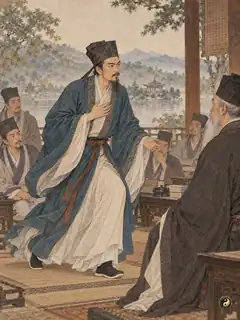
Mural of the event “Zhu Xi's Neo-Confucianism”, which this person took part in.
Since the Northern Song, Confucianism absorbing Buddhism and Daoism thought had formed a new theoretical form, urgently requiring a master who could systematically integrate the various views of all schools. Song-era scholar-officials had strong spiritual demand for Confucian revival.
Lu Jiuyuan, courtesy name Zijing, came from Jinxi in Fuzhou (in modern Jiangxi) and passed the jinshi examination in 1172. In 1175 Lu Zuqian brought him and his brother Lu Jiuling to meet Zhu Xi at Goose Lake Temple, where the two sides disagreed over how learning should proceed; in 1181, at Zhu's invitation, he lectured at the White Deer Grotto Academy on the Analects passage contrasting the gentleman's concern for rightness with the small man's concern for profit, and some listeners wept. After serving as a county registrar and in the Directorate of Education, he taught on Yingtian Mountain near Guixi and called himself the Old Man of Xiangshan. He taught that the mind is principle. Sent to govern Jingmen in 1191, he walled the town and strengthened its defences, and died in office early in 1193, aged fifty-four; he was later named Wen'an. Wang Shouren, prefacing his collected works, judged his learning to be the learning of Mencius.
The Song History says Lu Jiuyuan took the jinshi in 1172; on returning home, scholars flocked to him, and whenever he gave a lecture the shoes outside the door were piled up while elders came leaning on staffs to listen. He called himself the Old Man of Xiangshan and scholars called him Master Xiangshan; when Guangzong took the throne he was made prefect of Jingmen military district. He said that what happens in the universe is one's own business and the reverse, and that this mind is the same and this principle is the same.

 Song

 Literature · Prose
