Southern Song Neo-Confucian whose Collected Commentaries on the Four Books became the set text of the civil examinations from the Yuan onward
Mural guide
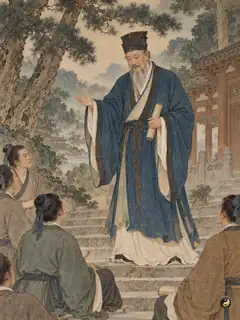
Mural of the event “Zhu Xi's Neo-Confucianism”, which this person took part in.
Since the Northern Song, Confucianism absorbing Buddhism and Daoism thought had formed a new theoretical form, urgently requiring a master who could systematically integrate the various views of all schools. Song-era scholar-officials had strong spiritual demand for Confucian revival.
Zhu Xi, courtesy names Yuanhui and Zhonghui, styled Hui'an and in old age Huiweng, came from a family of Wuyuan in Huizhou and was born at Youxi in Nanjianzhou. He passed the jinshi examination in 1148 and later studied with Li Tong, a third-generation follower of Cheng Yi, going on to systematize the teachings of the Cheng brothers. He served as registrar of Tong'an and as prefect of Nankang, Zhangzhou and Tanzhou; at Nankang he restored the White Deer Grotto Academy and drew up its rules. In 1194 he was called to lecture to Emperor Ningzong but was dismissed after little more than forty days, and in the Qingyuan ban that followed his teaching was condemned as false learning. He died at Kaoting in Jianyang in 1200 and was later granted the posthumous name Wen. In 1313 the Yuan court made his *Collected Commentaries on the Four Books* (*Sishu zhangju jizhu*) the basis of the civil examinations.
1175Zhu Xi's Neo-ConfucianismTook partage 45The official ideology that shaped East Asian intellectual elite's spiritual world for seven centuries.
Zhu Xi Restores Bailudong Academy1179age 49In 1179, while governing Nankang, Zhu Xi restored Bailudong Academy, appointed teachers, endowed fields, and formulated the Bailudong Academy Precepts.
Zhu Xi Establishes Wuyi Jingshe1183age 53In 1183 Zhu Xi established Wuyi Jingshe at Mount Wuyi, teaching and writing there and making the academy a physical center of his Neo-Confucian learning.
Zhu Xi Inspecting Education in Zhangzhou1190age 60In 1190, Zhu Xi became prefect of Zhangzhou and pursued reforms associated with his program of public ethics and local education.
Pursued principle for knowledge, with reverence as the base
Southern Song
Zhu Xi's learning, in broad terms, was to investigate principle in order to reach knowledge, to examine himself in order to carry it out in practice, and to take reverence as the main thing. He wrote collected commentaries on the Analects and the Mencius, and his explanations of the Great Learning, the Analects, the Mencius and the Doctrine of the Mean were later adopted in the state schools.
Found the White Deer Grotto site and asked for its revival
Southern Song
Zhu Xi visited the site of the White Deer Grotto Academy, asked in a memorial for it to be restored, and drew up rules of study for the students to keep. From time to time he went to the prefectural school and invited scholars to discuss with him, and he lectured to his students every day without pause. When some urged him to send the students away he only laughed, and he shared plain meals with those who came from far away.

 Song

 Literature · Prose
 Treasures · Brushwork


