
Artists › Painters and Calligraphers
Zhao Mengfu
Descendant of the Song imperial house who served the Yuan as a Hanlin academician and whose calligraphy and landscapes set the course of Yuan painting and writing
A desk holds an unrolled sheet bearing three bold black ink strokes, with a rack of many brushes above it, a stone ink slab and ink stick, a porcelain bowl, a red lacquer box, a dish of red seal paste and a paperweight; a small seated figure shows through a round window onto bamboo.
Also known as Zi Ziang · Hao Song Xue Dao Ren
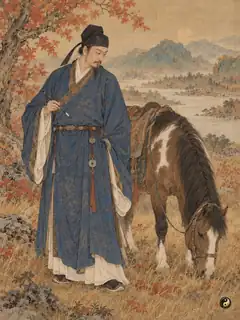
Zhao Mengfu, courtesy name Zi'ang (Songxue Daoren), came from Wuxing in Huzhou and descended from Zhao Defang, a son of the first Song emperor. After the fall of the Song he lived at home until 1286, when Cheng Jufu, sent south to seek out men of talent, recommended him, and Khubilai made him a director in the Ministry of War; under Emperor Renzong he rose to recipient of edicts in the Hanlin Academy. He wrote every script from seal to cursive, and his manner became known as the Zhao style; his paintings include Autumn Colours on the Que and Hua Mountains and Watering Horses in the Autumn Fields. His wife Guan Daosheng and son Zhao Yong were also painters and calligraphers. He died at home in 1322 aged sixty-nine and was named Wenmin, Duke of Wei. Since the Ming he has been counted with Ouyang Xun, Yan Zhenqing and Liu Gongquan as one of the four masters of regular script.
Life and times
Dates 1254 CE–1322 CE