Wei scholar-official, grandson of He Jin and stepson of Cao Cao, who led the Zhengshi school of Dark Learning and compiled the Collected Explanations of the Analects
Mural guide
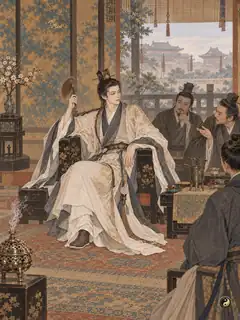
Mural of the event “Flourishing of Neo-Daoist Thought”, which this person took part in.
Following the collapse of Han Confucian scholasticism amid bloody political purges, literati sought ontological truth and existential refuge from rigid orthodoxy.
He Yan, courtesy name Pingshu, was from Wan in Nanyang and a grandson of the Han regent He Jin. Cao Cao took his mother as a consort, and the boy grew up in Cao's household dressed like an heir, which made Cao Pi scorn him as a stepson; he later married the Princess of Jinxiang. Sidelined under the first two Wei emperors, he joined Cao Shuang in the Zhengshi era and rose to head the Board of Civil Office, controlling appointments. Fond of Laozi and Zhuangzi, he wrote an Essay on the Dao and its Virtue and with Wang Bi argued that being rests on non-being, later called the voice of Zhengshi. With Sun Yong, Zheng Chong, Cao Xi and Xun Yi he submitted the Collected Explanations of the Analects (Lunyu jijie). When Sima Yi seized power in 249, He Yan was executed with Cao Shuang and his whole clan. His commentary is the oldest complete one on the Analects and is included in the Thirteen Classics with Commentaries.
240Flourishing of Neo-Daoist ThoughtTook partThe Bamboo Grove Sages and metaphysical ontology, sparking individual awakening and literati aesthetic freedom.
Wang Bi and He Yan Foundc. 240In the Zhengshi era, young philosophers Wang Bi and He Yan synthesized Daoist cosmology with Confucian ethics, revolutionizing Chinese intellectual thought.
The Records of the Three Kingdoms says He Yan was a grandson of He Jin, and a note quoting the Weilue says that when Taizu (Cao Cao) was Minister of Works he took He Yan's mother and brought up He Yan himself, often calling him a stepson. He became known while young for his talent, liked the words of Laozi and Zhuangzi, and wrote the Discourse on the Way and Virtue together with dozens of other essays, poems and writings. He was later made a Shangshu in charge of selecting officials, and when Cao Shuang and the others were arrested, He Yan was put to death with them and his family to the third degree was exterminated.

 Han
 Three Kingdoms

 Literature · Prose


