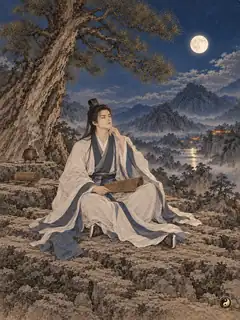
Wei-period philosopher who, before dying at twenty-four sui, wrote the commentaries on the Laozi and the Book of Changes that became core texts of Profound Learning (xuanxue)
Mural guide
Mural of the event “Flourishing of Neo-Daoist Thought”, which this person took part in.
Following the collapse of Han Confucian scholasticism amid bloody political purges, literati sought ontological truth and existential refuge from rigid orthodoxy.
Wang Bi, courtesy name Fusi, belonged to the Wang family of Gaoping in Shanyang. According to He Shao's biography of him, quoted in Pei Songzhi's notes to the Records of the Three Kingdoms (Sanguozhi), the personnel minister He Yan admired him as someone with whom one could discuss the boundary between heaven and humanity. He wrote commentaries on the Laozi and the Book of Changes (Zhouyi), along with an outline of the Changes, reading the hexagrams for their meaning and setting aside the numerological methods of Han scholars. The Book of Jin (Jinshu) says that he and He Yan held that all things in heaven and earth have non-being as their root. After Cao Shuang's fall in 249 he lost his post, and that autumn he died of an epidemic disease at twenty-four sui, leaving no son. Kong Yingda's Tang-dynasty Correct Meaning of the Five Classics built its volume on the Changes on Wang Bi's commentary.
240Flourishing of Neo-Daoist ThoughtTook partage 14The Bamboo Grove Sages and metaphysical ontology, sparking individual awakening and literati aesthetic freedom.
Wang Bi and He Yan Foundc. 240In the Zhengshi era, young philosophers Wang Bi and He Yan synthesized Daoist cosmology with Confucian ethics, revolutionizing Chinese intellectual thought.
249 CEDied
Works
Literature · Prose16
Commentary on the LaoziThree KingdomsWang Bi's Wei-era commentary on the Laozi, rooted in non-being; a founding work of xuanxue
Pei Songzhi's commentary quotes He Shao's Life of Wang Bi: Wang Bi was bright from childhood, was drawn to the Laozi in his early teens, and was a ready debater. He Yan sighed that here was a man to discuss the bounds of heaven and man with, and Wang Bi was later made a gentleman of the Secretariat. He commented on the Laozi, wrote a Daolue lun, commented on the Changes, held that the sage surpasses others in spirit while sharing their five emotions, and died at twenty-four.

 Three Kingdoms

 Literature · Prose


