
Writers › Writer / Poet
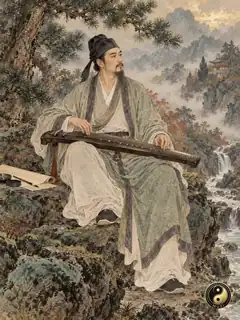
Wang Wei
High Tang poet, painter and musician whose quiet landscape verse came from his Wangchuan estate, and who ended his career as assistant director of the Department of State Affairs
Mural of Autumn Twilight in the Mountain Dwelling, a work by this person.
After autumn rain, a clear spring passes over stones beneath moonlit pines while washerwomen move quietly among bamboo. A small fishing boat parts lotus leaves as evening settles over the mountain retreat.
Also known as Zi Moji · Hao Mo Ji Ju Shi · Wang Youcheng · Shi Fu
Wang Wei, courtesy name Mojie, had family roots near Taiyuan, but his father settled in Puzhou. Passing the jinshi examination in the Kaiyuan reign, he became an assistant director of court music but was soon demoted to a granary post in Jizhou; under Zhang Jiuling he was promoted to Reminder of the Right, and later served on the Hexi frontier staff. Captured when An Lushan's rebels took Chang'an, he was forced to accept a post in their government, but a poem on Ningbi Pond expressing longing for the Tang court, and his brother Wang Jin's offer to give up his own rank, won him a light demotion after the war. In later years he kept an estate at Wangchuan in Lantian, where he and Pei Di wrote the poems of the Wangchuan Collection. He rose to assistant director of the Department of State Affairs and died in 761. Su Shi wrote that there are paintings in his poems and poems in his paintings.
Life and times
Dates c. 701 CE–761 CE (birth by another account 699)