
Writers › Writer / Poet
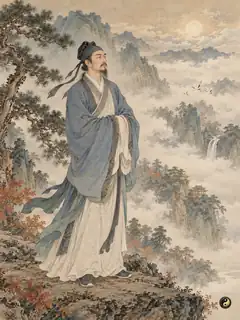
Sikong Tu
Late Tang poet and critic who withdrew to the Zhongtiao Mountains and starved himself after the last Tang emperor was murdered; his authorship of the Twenty-four Moods of Poetry is disputed
In a study at night, a desk holds a brush pot, a porcelain vase with a plum branch, a lit red lantern, a folded fan and an unrolled blank scroll, with no one seated there, while through a round window the moon rises over a lake with a sailboat.
Also known as Zi Biaosheng · Nairu Jushi
Sikong Tu, courtesy name Biaosheng, came from Yuxiang in Hezhong and passed the jinshi examination in 869 under the examiner Wang Ning, who admired his writing. He held posts such as vice-director in the Ministry of Rites, fled home when Huang Chao took Chang'an, and later served Emperor Xizong's court in exile as a drafter of edicts. As the dynasty collapsed he retired to the Wangguan Valley in the Zhongtiao Mountains and refused repeated summonses on grounds of illness, including the Later Liang's offer of a ministry. In 908, on hearing that the last Tang emperor had been murdered, he stopped eating and died at seventy-two sui. In his letter to a Mr Li on poetry he argued that a poem's flavour should lie beyond its literal taste, an idea Su Shi quoted in an essay on another poet's collection. The Twenty-four Moods of Poetry (Ershisi shipin), long attributed to him, has been questioned since the 1990s.
Life and times
- 837 CEBorn
 Tang
 Five Dynasties and Ten Kingdoms
- 908 CEDied
Works
 Literature · Criticism25
- The Twenty-Four Categories of PoetryTangTwenty-four rhymed portraits of poetic moods, ascribed to Sikong Tu of the late Tang
- The Twenty-Four Categories of Poetry: The Grand and PotentTang
- The Twenty-Four Categories of Poetry: The Placid and MildTang
- The Twenty-Four Categories of Poetry: The Elegant and ClassicalTang
- The Twenty-Four Categories of Poetry: The Bold and UnrestrainedTang
+20 more
- The Twenty-Four Categories of Poetry: The Delicate and LushTang
- The Twenty-Four Categories of Poetry: The Concentrated and GraveTang
- The Twenty-Four Categories of Poetry: The Lofty and AncientTang
- The Twenty-Four Categories of Poetry: The Washed and RefinedTang
- The Twenty-Four Categories of Poetry: The Vigorous and StrongTang
- The Twenty-Four Categories of Poetry: The Embellished and BeautifulTang
- The Twenty-Four Categories of Poetry: The NaturalTang
- The Twenty-Four Categories of Poetry: The Reserved and ImplicitTang
- The Twenty-Four Categories of Poetry: Spirit and VitalityTang
- The Twenty-Four Categories of Poetry: The Close-Woven and DenseTang
- The Twenty-Four Categories of Poetry: The Untrammeled and RusticTang
- The Twenty-Four Categories of Poetry: The Pure and RareTang
- The Twenty-Four Categories of Poetry: The Winding and SubtleTang
- The Twenty-Four Categories of Poetry: The Actual SceneTang
- The Twenty-Four Categories of Poetry: The Sorrowful and IndignantTang
- The Twenty-Four Categories of Poetry: DescriptionTang
- The Twenty-Four Categories of Poetry: The TranscendentTang
- The Twenty-Four Categories of Poetry: The Drifting and AloofTang
- The Twenty-Four Categories of Poetry: The Expansive and FreeTang
- The Twenty-Four Categories of Poetry: Flowing MovementTang
- Literature · Sayings9
- Holding the Centre of the RingTangAphorism from the Twenty-Four Modes of Poetry: grasping the still centre of things
- Washing One's Feet at Fusang Where the Sun RisesTangFamous line from the Twenty-Four Moods of Poetry: the bold mode's cosmic sweep
- Buying Spring Wine in a Jade FlaskTangFamous line from the Twenty-Four Moods of Poetry: wine, rain and a thatched hut
- True Strength Brimming Over: The Bold and Unrestrained ModeTangFamous line from the Twenty-Four Moods of Poetry: inner strength filling all things
- Strength Stored Becomes Grandeur: The Potent and Vast ModeTangFamous line from the Twenty-Four Moods of Poetry: vigour stored becomes grandeur
+4 more
- Bold and Unbridled: the Heroic Style in Poetry and LifeTangIdiom from the History of the Northern Dynasties: the bold, free spirit of Zhang Yi
- Enjoying the Rain in a Thatched Hut: the Elegant Mode of PoetryTangAphorism from the Twenty-Four Categories, The Elegant: enjoying rain from a thatched hut
- Transcending Outward Forms: the Grand and Potent Mode of PoetryTangIdiom from the Twenty-Four Categories, The Grand and Potent: going beyond images to the centre
- Drinking In the Great HarmonyTangFamous line from the Twenty-Four Poetic Moods: the calm of drinking in great harmony