Indian monk who came to Luoyang with Kasyapa Matanga and is credited with the Sutra in Forty-two Sections
Mural guide
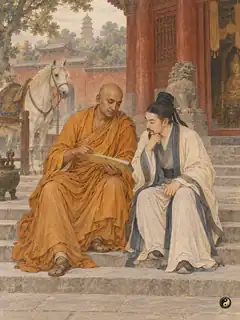
Mural of the event “Arrival of Buddhism in China”, which this person took part in.
Following a vision of a radiant golden deity, Emperor Ming of Eastern Han dispatched envoys Cai Yin and Qin Jing to the Western Regions to seek Buddhist teachings.
Zhu Falan, whose name is reconstructed as Dharmaratna, was a monk from central India who knew Chinese. Huijiao's Biographies of Eminent Monks says that he came to Luoyang with Kasyapa Matanga at the invitation of the envoy Cai Yin and translated five works; four were later lost, and only the Sutra in Forty-two Sections survives, traditionally held to be the earliest extant Chinese Buddhist translation. He died in Luoyang in his sixties. Tradition dates his arrival to 67.
68Arrival of Buddhism in ChinaTook partEmperor Ming welcoming Indian monks on white horses, establishing White Horse Temple and Chinese Buddhism.
75 CEDied
Posthumous
300Buddhism Spreading EastPrecursorBuddhist monks and texts reached Han lands through Central Asia; translation and monasteries gradually embedded the new religion in local society.
Works
Literature · Prose1
Sutra of Forty-Two SectionsHanBuddhist sayings credited to Kasyapa Matanga and Dharmaratna, held the first sutra in Chinese
Lived with Matanga in Luoyang and translated five scriptures
Eastern Han (years not given)
The Biographies of Eminent Monks says Zhu Falan was also from Central India; he and Kasyapa Matanga shared the aim of roaming and teaching and so came together. Once in Luoyang he lived with Matanga and soon spoke Chinese well. His translations were five works, the Shidi duanjie, Fo bensheng, Fahai zang, Fo benxing and the Forty-two Sections, of which the Sutra in Forty-two Sections alone survives, about two thousand characters. He later died in Luoyang, in his sixties.

 Han

 Literature · Prose


