
Royals › Monarch / Emperor
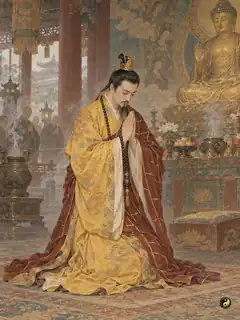
Xiao Yan
Founder of the Liang who reigned for nearly fifty years, four times gave himself to the Tongtai monastery, and died confined in Jiankang after Hou Jing's rebels took the palace city
Mural of the event “Buddhism Spreading East”, which this person took part in.
Society since the late Han had been long ravaged by war, and elite and common alike sought new spiritual consolation. The opened Silk Road provided the physical conduit and cultural bridge for foreign religion to travel east from the Western Regions.
Also known as Zi Shuda · Emperor Wu of Liang
Xiao Yan, courtesy name Shuda, came from Southern Lanling and under the Southern Qi belonged to the circle of eight writers around Prince Xiao Ziliang of Jingling. As governor of Yongzhou he rose in arms at Xiangyang in 501, took Jiankang, and in 502 accepted the abdication of Emperor He of Qi, founding the Liang; his reign titles ran from Tianjian to Taiqing. In 505 he appointed scholars for each of the Five Classics and opened schools for young men. He wrote the *Essay on Abstaining from Wine and Meat* (*Duan jiu rou wen*) for monks and nuns, and from 527 he four times gave himself to the Tongtai monastery, each time ransomed by the court. In 548 Hou Jing, a defector from the Eastern Wei, rebelled; his men took the palace city the next year, and the confined emperor died that summer of illness and hunger and was named Emperor Wu, temple name Gaozu. The lifelong vegetarian rule of Chinese Buddhist monks is usually traced to his ban.
Life and times
Dates 464 CE–549 CE
- 300Buddhism Spreading EastTook part
- 527Emperor Wu of Liang Enters Monasteryage 63
- 538Emperor Wu Holds Ullambana Feastage 74
- 548Hou Jing RebellionIn powerage 84
- 548Hou Jing Besieges Taichengage 84