
Writers › Writer / Poet
Su Xun
Northern Song essayist from Meishan, father of Su Shi and Su Zhe, who began serious study at twenty-seven and won fame when Ouyang Xiu presented his essays to the court
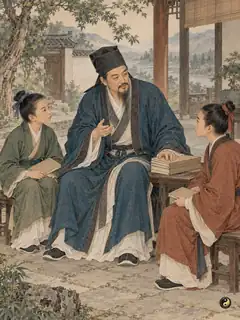
In a study at night, a desk holds a brush pot, a porcelain vase with a plum branch, a lit red lantern, a folded fan and an unrolled blank scroll, with no one seated there, while through a round window the moon rises over a lake with a sailboat.
Also known as Zi Mingyun · Hao Laoquan
- Roles
- Writer / Poet
Su Xun, courtesy name Mingyun, came from Meishan in Meizhou (in modern Sichuan). The History of the Song (Songshi) says he began to study in earnest only at twenty-seven, failed the jinshi and a special examination, then burned his drafts and immersed himself in the classics. In the Zhihe and Jiayou reigns he took his sons Su Shi and Su Zhe to the capital, where Ouyang Xiu presented twenty-two of his essays to the court and officials passed them eagerly around. Declining a test at the Secretariat, he was made a collator in the Imperial Library and, as registrar of Wen'an county, compiled with Yao Pi the hundred-chapter ritual code Taichang yingeli. He died in 1066, aged fifty-eight, just after it was submitted, and at Su Shi's request received a posthumous rank. His collected writings, the Jiayou ji, include the essay On the Six States. Ouyang Xiu wrote his epitaph, and Mao Kun of the Ming included him among the eight prose masters of Tang and Song.
Life and times
- 1009 CEBorn
 Song
- 1066 CEDied
Works
 Literature · Prose26
- Treatise on the Six StatesSongSu Xun's essay blaming the six states' fall on bribing Qin, a warning against Song tribute
- Mental Artistry of CommandSongSu Xun's essay on generalship: mastering the mind, nurturing morale and reading the moment
- On Guan ZhongSongSu Xun blames Guan Zhong for Qi's collapse: dying, he named no worthy man to succeed him
- On Discerning the TreacherousSongSu Xun on reading faint signs: a man who defies ordinary human feeling hides great treachery
- Record of the Portrait of Zhang of YizhouSongSu Xun on the portrait Shu kept of Zhang Fangping, who calmed a land on the edge of revolt
+21 more
- On the Book of ChangesSongSu Xun argues that the sages made the rites to be trusted and the Book of Changes to be revered
- On MusicSongSu Xun on why the sages needed music: rites fade once their threat of death is not believed
- On the Book of SongsSongSu Xun on the Book of Songs as a safety valve: desire and grievance allowed, within limits
- On the Book of DocumentsSongSu Xun reads the Book of Documents as a history of changing custom, from Yao to King Wu
- On Clear SightSongSu Xun on governing by knowing a few things well, with the sun, the thunder and King Wei of Qi
- On Remonstrance, Part OneSongSu Xun urges remonstrators to borrow the five arts of the travelling persuaders
- On Remonstrance, Part TwoSongSu Xun on making ministers speak up: reward like gold, punishment like a tiger at their backs
- Essays on Expediency: Sun WuSongSu Xun tests Sun Wu against his own Art of War and finds the general short of the book
- Essays on Expediency: Emperor GaozuSongSu Xun reads Han Gaozu's last orders as a plan to use Empress Lü yet cut her faction down
- Essays on Expediency: Xiang JiSongSu Xun argues Xiang Ji lost the realm at Julu by not racing for the passes first
- Essays on Balance: Handling GeneralsSongSu Xun on handling generals: reward the great ones first, make the small ones earn it
- Essays on Balance: Enforcing the LawSongSu Xun on why good laws still fail: five open violations everyone sees and no one questions
- Essays on Balance: The Land SystemSongSu Xun on land: the well fields cannot return, but a cap on holdings could bring their benefits
- Introduction to the Su Clan GenealogySongSu Xun sets out the rules of his clan genealogy, made so kin would not drift into strangers
- Later Record to the Su Clan GenealogySongSu Xun traces the Su from Gaoyang to Meizhou and bases his genealogy on the lesser lineage
- Letter to Privy Councillor HanSongSu Xun warns Grand Commandant Han that idle, pampered troops breed trouble and urges strict law
- Letter to Hanlin Academician OuyangSongSu Xun ranks Ouyang Xiu's prose with Mencius and Han Yu and tells how he learned to write
- Preface Seeing Off Shi Changyan as Envoy to the NorthSongSu Xun recalls a kinsman who fed him chestnuts as a boy, and urges him not to be cowed abroad
- On Giving My Second Brother the Style Name WenfuSongSu Xun renames his elder brother and finds the finest pattern where wind meets water
- On Naming My Two SonsSongSu Xun names his sons after a carriage's crossbar and ruts: fear for one, hope for the other
- Record of the Driftwood MountainSongSu Xun reads luck, fate and character in a three-peaked mountain of driftwood kept at home
- Literature · Sayings3
- Carrying Firewood to Fight a FireSongIdiom used in Su Xun's Treatise on the Six States: fighting fire with firewood
- Pared Away Day by Day, Month by MonthSongIdiom from Su Xun's On the Six States: land ceded bit by bit until nothing is left
- Unmoved Though Mount Tai Collapse Before Him: Su Xun on GeneralshipSongLine from Su Xun's essay on the mind: perfect composure before disaster
Family tree
- Direct kin
 Su XunSon

