
Writers › Writer / Poet
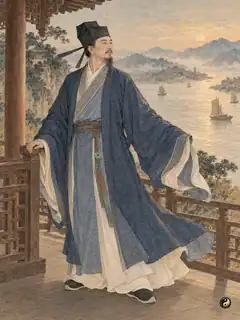
Su Zhe
Northern Song writer and minister, younger brother of Su Shi, who rose to vice-director of the Chancellery under Zhezong and spent his last years in seclusion at Xuzhou
In a study at night, a desk holds a brush pot, a porcelain vase with a plum branch, a lit red lantern, a folded fan and an unrolled blank scroll, with no one seated there, while through a round window the moon rises over a lake with a sailboat.
Also known as Zi Ziyou · Hao Ying Bin Yi Lao · Luan Cheng · Wen Ding · Zi Tongshu
Su Zhe, courtesy names Ziyou and Tongshu, was the younger son of Su Xun of Meishan. He passed the jinshi examination with his brother Su Shi in 1057 and openly criticised Emperor Renzong in the decree examination of 1061. Opposing Wang Anshi's green-sprouts loans, he left the capital early in the Xining era, and when Su Shi was jailed over his poems in 1079 he offered his own rank to redeem him and was demoted to a tax post at Yunzhou. Recalled under Zhezong, he became assistant director of the Department of State Affairs in 1091 and then vice-director of the Chancellery. After protesting the revival of the reforms in 1094 he was exiled as far as Leizhou and Xunzhou. Under Huizong he settled at Xuzhou as the Old Recluse of the Ying Shore and lived in near silence until his death in 1112; he was later canonised as Wending. Su Shi told Zhang Lei that Ziyou's prose was better than his own, though the world did not see it.
Life and times
- 1039 CEBorn
 Song
- 1079Su Shi's Crow Terrace Poetry Case
 age 40In 1079 censors charged Su Shi, prefect of Huzhou, with mocking the new laws in his poems; he was jailed and tried at the Censorate and then banished to Huangzhou.
- 1112 CEDied
Works
 Literature · Prose16
- Letter to Grand Commandant Han of the Bureau of Military AffairsSongYoung Su Zhe's letter seeking to meet Han Qi: good writing grows from a nurtured spirit
- Record of the Pavilion of Supreme Delight in HuangzhouSongSu Zhe's record of Zhang Huaimin's river pavilion in Huangzhou, on finding delight in exile
- Essay on the Six StatesSongSu Zhe on why the six states fell to Qin: they did not see that Han and Wei were their shield
- Treatise on the ShangSongSu Zhe on why gentle Zhou lasted longer than hardy Shang, yet could never rise again
- Treatise on the Three KingdomsSongSu Zhe on why the Three Kingdoms rulers, all clever and bold, could not win the realm
+11 more
- Treatise on Emperor Wen of HanSongSu Zhe on Emperor Wen's patience, and why Chao Cuo's push to cut the princes caused the revolt
- Treatise on the Tang Balance of PowerSongSu Zhe defends Taizong's frontier governors and militia, blaming Tang's fall on misuse
- Preface to the Yuanyou State AccountsSongSu Zhe prefaces the state accounts and traces how Song finances turned from plenty to want
- Preface to the Section on the People's TaxesSongSu Zhe on why three revived ancient policies, militia, state loans and land surveys, failed
- On the Ruler's Arts, Fifth Policy EssaySongSu Che's policy essay: the ruler must read the realm's mood and channel it like a flood
- On the Ministers' Service, First Policy EssaySongSu Che tells the usurping minister from the weighty one, and asks that the weighty have room
- On Governing the People, First Policy EssaySongSu Che argues the Kingly Way must reach the villages, led by respected local farmers and sons
- On Governing the People, Second Policy EssaySongSu Che argues the people follow what pays, and asks to restore a degree for filial conduct
- The Nine-Bend Pavilion at WuchangSongSu Zhe on the hillside pavilion his brother Su Shi built across the river from Huangzhou
- The East StudioSongSu Zhe, demoted to tax salt and wine, laughs at his idle studio and at last understands Yan Hui
- Offering to Chancellor Sima on Behalf of the Three DepartmentsSongSu Zhe mourns Sima Guang for the court: recalled in a crisis, he ruled by sincerity
- Literature · Sayings2
- How Refreshing Is This WindSongAphorism from Su Zhe's Pavilion of Delight: the king's cry as a breeze sweeps in
- Letting No Outward Thing Wound One's Inner NatureSongFamous line from Su Zhe's Record of the Pavilion of Delight: a heart at ease anywhere
Family tree
- Direct kin


Connections
- Shared events1
