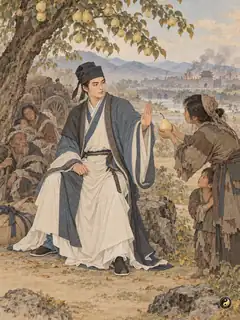
Major Yuan Neo-Confucian philosopher and scholar who co-directed the theoretical foundation of the Shoushi Calendar.
Mural guide
Mural of the event “Promulgation of Shoushi Calendar”, which this person took part in.
Accumulated errors in inherited calendars led to inaccurate celestial predictions; Kublai Khan ordered a nationwide astronomical survey to formulate a definitive imperial calendar.
Xu Heng (1209 CE–1281 CE) was the preeminent Neo-Confucian master of the Yuan Dynasty. He led the imperial educational academy and provided the theoretical framework that legitimized and coordinated the Shoushi Calendar reforms.
1280Promulgation of Shoushi CalendarTook partage 71Guo Shoujing, Wang Xun, Xu Heng, and their collaborators compiled the Shoushi calendar using observations gathered across an unusually broad network of sites.
The History of the Yuan says Xu Heng obtained from Yao Shu of Liucheng the writings of the Cheng family of Yi-Luo and the Zhu family of Xin'an, and gained much from them. He then became head of the Imperial Academy, and was later made Grand Scholar of the Jixian Hall while keeping that post, personally choosing Mongol youths to teach.
The History of the Yuan says Wang Xun was ordered to compile a new calendar and held that calendar makers knew the numbers but not the principles, so Xu Heng should lead it. Xu Heng and the Grand Astronomer Guo Shoujing and others made new instruments and gnomons. When the calendar was finished and presented, it was named the Shoushi Calendar and issued across the realm.

 Song
 Yuan

 Literature · Prose
