
Ministers › Remonstrators
Ji Zi
Late Shang noble who, by the Shiji's account, feigned madness when King Zhou ignored his advice and later expounded the Great Plan to King Wu of Zhou
Mural of the event “Tyranny of King Zhou”, which this person took part in.
In the late Shang, King Di Xin (Zhou) inherited a dynasty at its financial and military peak. But he gradually sank into personal indulgence, sharpened conflict with the rising western Zhou, and exiled honest counsel from his court.
Also known as Zi Xuyu
Jizi was a noble of the late Shang; one tradition gives his personal name as Xuyu, and Ji is usually taken to be his fief. The 'Hereditary House of Weizi of Song' in the *Records of the Grand Historian* (*Shiji*) calls him a kinsman of King Zhou, whom early commentators variously made his uncle or his elder half-brother. In that account, when the king began eating with ivory chopsticks Jizi foresaw ever greater extravagance, and when his remonstrance went unheeded he let down his hair, feigned madness and lived as a slave, playing the zither in private grief. After King Wu of Zhou conquered the Shang he visited Jizi, who set out the nine divisions of the Great Plan, preserved as the 'Hongfan' chapter of the *Book of Documents* (*Shangshu*). The *Shiji* adds that King Wu enfeoffed him in Joseon without making him a subject, a claim that scholars widely dispute. In the *Analects* (*Lunyu*) Confucius names Weizi, Jizi and Bigan as the three men of humaneness of Yin.
Life and times
 Shang
 Zhou

Works
 Literature · Poetry1
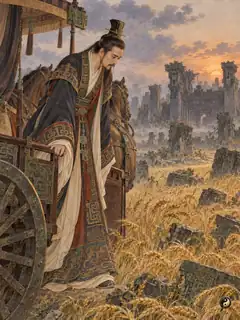
- Song of the Ripening WheatZhouSong ascribed to Jizi on passing the ruins of the Shang capital, recorded by Sima Qian
- Literature · Prose1
- Literature · Sayings1
- Ripening Wheat and Drooping Millet: Lament for a Fallen StateZhouIdiom joining Jizi's Song of Ripening Wheat and the Drooping Millet ode: grief for a lost state

