Warring States Ru thinker from Zou who argued that human nature is good and urged rulers of Qi and Liang to govern by benevolence
Mural guide
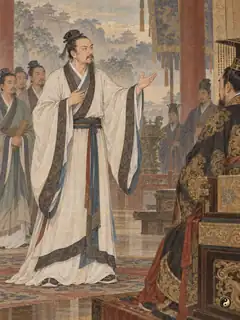
Mural of the event “Hundred Schools Contention”, which this person took part in.
At the turn of the Spring and Autumn and Warring States periods the rites collapsed and the old patrilineal social order gradually fragmented. The rise of private academies offered commoner scholars an unprecedented public arena to debate politics and life.
Mencius, personal name Ke, came from the small state of Zou (modern Zoucheng, Shandong). The Records of the Grand Historian (Shiji) says he studied under the followers of Zisi, the grandson of Confucius. He put his case to King Xuan of Qi and to King Hui of Liang (Wei), urging government by benevolence and the kingly way, but rulers busy with alliances and war found his advice impractical. In old age he withdrew with disciples such as Wan Zhang and composed the seven books of the Mencius (Mengzi), which hold that human nature is good and that the people matter more than the ruler. His birth and death years are not securely recorded. Zhu Xi grouped the Mencius with the Analects, the Great Learning and the Doctrine of the Mean in his commentary on the Four Books, and in 1330 the Yuan court titled him Second Sage, Duke of Zou.
500 BCEHundred Schools ContentionTook partConfucian, Mohist, Daoist, Legalist, and other thinkers debated ethics, human nature, and government across the rival states.
Meng Ke toured Qi and Liang, then wrote the seven chapters of the Mencius
Warring States period
The Shiji says Meng Ke was a man of Zou who studied under a disciple of Zisi, served King Xuan of Qi, and then went to Liang, where King Hui found his words remote from practical matters. He withdrew with Wan Zhang and others to set in order the Odes and Documents, set out Confucius's thought and compose the seven chapters of the Mencius. The Mencius, in Gaozi A, records his saying that human nature is good, as water runs downward.

 Zhou

 Literature · Sayings


