Warring States Daoist thinker from Meng in Song, once a lacquer-garden official, whose parable-filled Zhuangzi argues for the equality of things
Mural guide
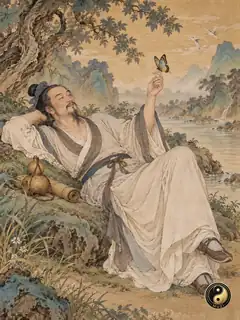
Mural of Zhuangzi, a work by this person.
Zhuangzi dreams among butterflies as the image opens into a giant kun transforming into the soaring peng above the northern sea. Dream and transformation blur the boundary between forms of life.
Zhuangzi, personal name Zhou, came from Meng in the state of Song (around modern Shangqiu, Henan). The Records of the Grand Historian (Shiji) says he served as an official of the lacquer garden at Meng and lived in the time of King Hui of Liang and King Xuan of Qi. When King Wei of Chu sent envoys with rich gifts to make him chief minister, he refused, saying he would rather play in a muddy ditch than be fattened as a sacrificial ox. He wrote more than a hundred thousand words, mostly in parables; the received Zhuangzi, edited by Guo Xiang of the Western Jin into thirty-three chapters in inner, outer and miscellaneous sections, includes Free and Easy Wandering and The Equality of Things. In 742 Emperor Xuanzong of Tang gave him the title True Man of Southern Florescence and renamed his book the True Classic of Southern Florescence (Nanhua zhenjing).
500 BCEHundred Schools ContentionTook partConfucian, Mohist, Daoist, Legalist, and other thinkers debated ethics, human nature, and government across the rival states.
c. 286 BCEDied
Works
Literature · Prose37
ZhuangziZhouDaoist book of Zhuang Zhou and his school: fables of free wandering and the equality of things
Zhuang Zhou of Meng, whose teaching returns to Laozi
Mid Warring States period
The Shiji says Zhuang Zhou was a man of Meng who served as a lacquer-garden clerk there, lived in the time of King Hui of Liang and King Xuan of Qi, and read widely, with a teaching that came back to the words of Laozi. King Wei of Chu, hearing of his worth, sent envoys with rich gifts to offer him the chief ministry; he replied that he would rather amuse himself in a muddy ditch, bound by no ruler, and never take office all his life.
Wrote over a hundred thousand characters, mostly parables
Mid Warring States period
The Shiji says Zhuang Zhou wrote more than a hundred thousand characters, mostly parables, among them the Fisherman, Robber Zhi and Trunk-Opening, and that he was skilled at joining phrases and describing events by analogy, so that even the learned of his day could not answer his attacks on the Confucians and Mohists. The Han History bibliography lists a Zhuangzi in fifty-two chapters under the Daoists.

 Zhou

 Literature · Prose


